|
Are You Prepared
for a Disaster?
Disaster preparedness
is something that every broadcast engineer must deal with. A session
at the upcoming NAB Broadcast Engineering Conference (BEC, April
10-15, 2010, Las Vegas, Nev. see below for additional information)
entitled Disaster Preparedness, Recovery and Security includes
a paper, excerpted here, which focuses on the experiences of Steve
Fluker, Director of Engineering with Cox Radio, Orlando, in dealing
with the aftermath of a tornado that destroyed one of Coxs Florida
facilities.
.jpg)
INTRODUCTION at 4 a.m. on February 2, 2007, I got a
phone call telling me that WCFB, 94.5 was off the air. The station
operator told me that there were severe storms near the tower
site so it could be related. I attempted to call the remote control
system, but the phone just rang with no answer. Next I tried the
wireless link through my PC, but again no response. Fearing the
worst, I called another engineer, grabbed my camera, and headed
for the tower site which was an hour drive away. When wearrived,
we were faced with the reality that this storm had produced an
F4 tornado which had taken down the 1,500 foot tower, and had
destroyed the transmitter building and all of the equipment inside
(see photo). Once the news got out that our tower was down, our
competitors started calling our clients telling them that we would
be off the air for months, and that they could handle our schedules.
That might have been the case had we not been prepared for what
to do in a situation like this.
GETTING BACK ON THE AIR Because of previous planning
and being prepared, we were able to get back on the air at 2:37
p.m. that same afternoon. The work that day included emergency
FCC filings to operate from a different tower, and to operate
with an emergency STL. This temporary signal covered the entire
metro Orlando area, and within a month, we were back up to full
power and full antenna height with a short term lease on another
nearby tall tower. This gave us the opportunity to take the proper
amount of time to rebuild the tower and building the right way
without cutting corners to speed up the project.
WHAT WILL BE ASKED OF YOU When a major disaster like
this one hits, you can bet that your telephone will begin ringing
and wont stop for days or even weeks. Your General Manager, program
director, and sales managers will all call wanting to know when
youll have the station back on the air. The business manager
will want to know how much this will cost and have you talked
to the insurance company yet. Among these calls will also be one
from your insurance adjuster asking for a list of all of the equipment
damaged, and the approximate value of each item. And Oh by the
way, they want it as soon as possible. In my case, they asked
if I could get the initial report to them within a week.
PROPER PREPARATION PAYS OFF There are a few steps that
you can do right now that will pay off when you come face to face
with a problem. First, come up with a document or book with all
of the information you will need in times of trouble. This Business
Continuity Plan should include the following:
- List all service providers that you do business with. This
includes telephone companies, Internet providers, power companies,
water Company, network programming providers, IT services, etc.
- Create a list of all emergency contacts that you may need.
This would include sheriffs department, fire department, local
hospitals, environmental protection agency, security companies,
poison control, and hazmat organizations. Also include the FCC
and FAA for NOTAM notifications (be sure to have all of your
tower registration numbers listed).
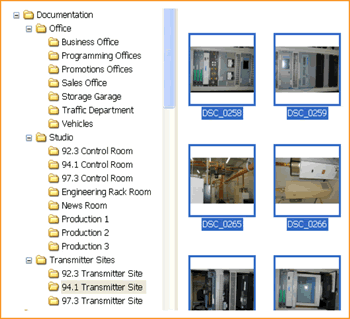
DOCUMENT WITH PHOTOS Now that you have a plan in place
you need to know what you have at all of your locations. The best
way to document your facilities is with pictures. A digital camera
can give you a very accurate and extensive record of what you
have at virtually no cost. Be sure to organize your pictures on
your computer under files based on your locations as shown in
the figure. Keep a copy of these photos on a backed up network
drive, as well as on CDs located at every tower site, and one
at your home. You can never have too many copies, or too many
pictures.
SUMMARY a disaster can strike at any time, and is usually
unexpected. Dont be in denial that this cant happen to you,
or that you have plenty of time to prepare later. Its too late
once the storm hits. Having the proper written plan, photos of
your facilities, old invoices, and copies of old drawings and
documentation can greatly reduce the stress when you come face
to face with a tragedy. Youll also build confidence with your
managers, corporate office, and the insurance company when you
show that you are organized and ready to face the challenge of
rebuilding, which is always a positive thing.
Mr. Fluker will present this paper on Wednesday, April 14, 2009
starting at 9:30 a.m. in room S226 of the Las Vegas Convention
Center. It will also be included in its entirety in the 2010 NAB
Broadcast Engineering Conference Proceedings, on sale at the 2010
NAB Show Store and available on-line from the NAB Store (www.nabstore.com)
after the convention. Other papers being presented during this
session include the following:
- Strategies for Disaster Preparedness: Staying on the Air
if the Worst Happens, Charles Kelly, Director of Sales,
Nautel
- Putting the Final Touches on Next-Generation EAS Panel,
moderated by Larry Walke, Associate General Counsel, NAB. Scheduled
panelists include Antwane Johnson, Division Director and Project
Manager, FEMA, James Barnett, Chief, Public Safety and Homeland
Security Bureau, FCC, Suzanne Goucher, President and CEO, Maine
Association of Broadcasters, Thomas Beers, Chief, Policy Division,
FCC, and Wade Witmer, Deputy Division Director, FEMA.
For additional conference information visit the NAB Show Web
page at www.nabshow.com.
2010 NAB
Broadcast Engineering Conference Summary of Presentations
Check out
the papers
that will be presented at the 2010 NAB Broadcast Engineering Conference
in Las Vegas, April 10-15, 2010.
No Better
Time to go to the NAB Show
Trade shows
save time and money. In tough economic times there is no more
efficient way to invest your time and travel money than in the
NAB Show especially with the Lowest Hotel Rate Guarantee Program.
Rates
are 20% lower than 2009!* Book your hotel via the NAB
Show Housing Site for guaranteed lowest hotel rates during
the NAB Show dates at participating hotels. If the hotel lowers
their rates or lower rates are found, NAB rates will AUTOMATICALLY
be lowered and new confirmations generated. Complimentary shuttle
bus service to/from the LVCC will only be provided to guests booked
within the official NAB Show Housing block. (*Published rates
are defined as rates available on the hotel Web sites over the
same arrival/departure pattern. Rates are based on the average
reduction of participating hotels.)
ADVERTISEMENT

|
ADVERTISEMENT

|
The
March 8, 2010 Radio TechCheck is also available
in an Adobe Acrobat file.
Please click
here to read the Adobe Acrobat version of Radio TechCheck
|

