|


|
Integrated Data Services for Enhanced Radio Broadcasting – Delivering Content for NextRadio and HD Radio Receivers
INTRODUCTION – there are two commercially-available enhanced local radio receiver platforms in the U.S.: NextRadio and HD Radio. The HD Radio platform utilizes a digital radio broadcast that includes Program Service Data (PSD) to deliver metadata and album artwork (and other images such as station logo) with a service that is called the “Artist Experience.” There are currently over 17 million HD Radio receivers in the market capable of receiving metadata. Artist Experience is available in new HD Radio car receivers from BMW, Buick, Chevrolet, GMC, Lexus, Mazda, Toyota and Volkswagen as well as CE manufacturers Alpine, Clarion, JVC, Kenwood, Pioneer, Sony and Insignia.
METADATA SERVICES – the delivery methods and scope of metadata for NextRadio and HD Radio differ, but each require the broadcaster to integrate metadata services at the local station in order to source, author, customize, and route enhanced content to the relevant delivery channel in sync with the broadcast audio. One significant difference between NextRadio and HD Radio is that NextRadio shifts the metadata distribution into a cloud-based Internet service for distribution to the receiver while HD Radio only sends metadata over the digital broadcast channel. Broadcasters can utilize Emmis’ TagStation data service for either NextRadio or HD Radio to manage the metadata relevant to each synchronized audio broadcast event. Operations supported by TagStation include song matches, linking campaigns to spots and promos, and configuring a broadcast schedule that displays during news, talk or sports segments. TagStation also enables the station to control how that station is displayed in the NextRadio app station guide (see example above). HOW METADATA SERVICES WORK – in a typical integration, raw data for songs/spots/promos is delivered from a station’s automation system to that station’s “middleware” software (examples include Center Stage Live, TRE, JumpGate, PADapult, and TagStation Slingshot) on an Internet-connected PC via TCP connection. The middleware's task is to parse through the “now playing” data and send the relevant fields and values to a secure, cloud-based system that matches the raw data with accurate album art and song metadata or linked campaigns for spots/promos. Emmis’ TagStation data service sends the enhanced now-playing data directly to NextRadio phones using an Advanced Message Queuing Protocol (AMQP) server. TagStation is also able to output data in XML format back to the middleware instantly. This enhanced data, including album art URLs, can then be delivered to an RDS encoder and HD Radio importer for broadcast. STATION ROLES AND WORKFLOW – in a time when most radio stations are already stretched thin doing more with fewer resources, the obvious question is, "who is going to do all this work matching content to the stations audio?" Enhancing a station's broadcast to meet the expectations of today's music consumer isn't a full time job, but there are some best practices that help stations get the most out of the time they are putting toward this effort.
Once a station's core library of songs is matched, maintaining the song library can take less than an hour a week. Most stations aren't adding a lot of new songs into heavy rotation from week to week. By revisiting the metadata system regularly and focusing on newly added un-matched songs, an accurate song database can be maintained with little effort by station personnel. Creating a basic station schedule for the first time can take a couple of hours depending on how many shows the station has. Once the most important recurring shows are present in the schedule, maintaining it is only a matter of managing exceptions like special events and modified schedules for vacations or holidays. This paper is
included in its entirety in the 2014
NAB BEC Proceedings. For additional conference information visit
the NAB Show Web page. |
|

The June 02, 2014 TechCheck is also available in an Adobe Acrobat file. |
|
 Advanced
radio receivers are capable of presenting artwork, program metadata,
and audience interaction opportunities to a listener, synchronized
with the audio portion of the radio broadcast, as well as supporting
other features such as local station guides. A session at this year’s
NAB Broadcast Engineering Conference (
Advanced
radio receivers are capable of presenting artwork, program metadata,
and audience interaction opportunities to a listener, synchronized
with the audio portion of the radio broadcast, as well as supporting
other features such as local station guides. A session at this year’s
NAB Broadcast Engineering Conference (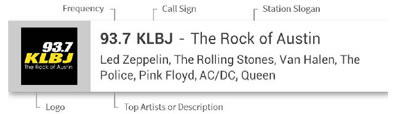 NextRadio
is a hybrid radio tuner application for smartphones that utilizes
the efficiency of existing, over-the-air broadcast signals for audio,
supplemented with metadata, album artwork and other images including
advertising, delivered over the Internet. In addition, NextRadio
utilizes standard smartphone features to deliver a rich, personal
experience to listeners, allowing them to purchase music, share
what they are listening to, and engage with the station or advertiser.
Shown at right is a typical station guide listing as shown in the
NextRadio “app.”
NextRadio
is a hybrid radio tuner application for smartphones that utilizes
the efficiency of existing, over-the-air broadcast signals for audio,
supplemented with metadata, album artwork and other images including
advertising, delivered over the Internet. In addition, NextRadio
utilizes standard smartphone features to deliver a rich, personal
experience to listeners, allowing them to purchase music, share
what they are listening to, and engage with the station or advertiser.
Shown at right is a typical station guide listing as shown in the
NextRadio “app.”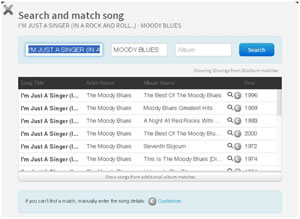 At
most radio stations, a member of the programming staff or digital
team is assigned the task of maintaining good song matches. The
TagStation data service is able to auto-match 75% or more of the
songs played for most formats. Even songs that are auto-matched
can typically be refined or customized in the database, see for
example the TagStation manual match interface screen shot shown
in the image to the right.
At
most radio stations, a member of the programming staff or digital
team is assigned the task of maintaining good song matches. The
TagStation data service is able to auto-match 75% or more of the
songs played for most formats. Even songs that are auto-matched
can typically be refined or customized in the database, see for
example the TagStation manual match interface screen shot shown
in the image to the right.