|



|
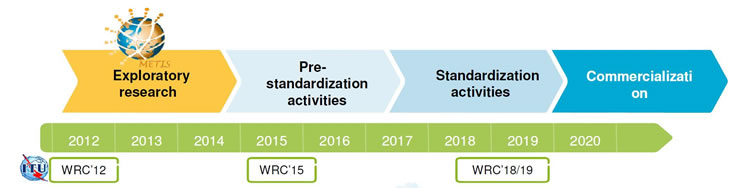
5G Concepts are Gaining Momentum The mobile wireless industry is planning to introduce so-called 5G wireless technology around the year 2020. 5G proponents are projecting a vision of very high data rate with high reliability and availability. Many industry experts think that 5G will be a disruptive technology; it not only will create new business opportunities but also may pose challenges to the existing broadcast model. Broadcasters will need to understand the threats and opportunities of the coming 5G technology and position their products and services accordingly. A review of the ETSI Summit on Future Mobile and Standards for 5G, held in November 2013, offers a glimpse of the possibilities of 5G. Twelve presenters form DG Connect, METIS, 3GPP, DVB, Deutsche Telekom AG, and many research universities shared their vision of the 5G technology. The presentations can be accessed here. Also, the February 2014 issue of the IEEE Communications Magazine published eleven articles summarizing the research direction of 5G. The European Commission officially formed the 5G Public-Private Partnership Association (5GPPP) in December 2013. Thirty-one companies including Alcatel-Lucent, Ericsson, Huawei, Intel, NEC, Nokia, and Samsung have developed proposals for the 5G infrastructure. The mobile wireless industry has historically introduced a new system about every ten years, and 5G is on schedule to be introduced in 2020. It is evident that 5G efforts are gaining steam. The main driver of 5G technology development seems to be the funding from the governments that believe 5G will boost economic activities. Basic research has already started, and the first round of proposals will be submitted in November 2014. Standardization of 5G is expected to start in 2018 and scheduled to be finished by 2020. It is also speculated that the first 5G systems will be deployed around 2020 and will become the dominant wireless technology by 2025. Mobile and wireless communications Enablers for the Twenty-twenty Information Society, is a European consortium of industry heavyweights, set its project objective as shown in the following figure.
Although everyone agrees that there will be a 5G system, there is little or no agreement about what it will be and how it will be achieved. In various ways, proponents envision that 5G will provide the perception of infinite capacity, which, in practical terms, means a reliable wireless link with a minimum throughput of 1 Gbps and low latency. Tactile internet and augmented reality are among the most hyped use cases. Internet of Things (IoT), cloud-based ecosystem, and virtualization of network functions are also included in the 5G vision. Although the technology for 5G is still unspecified, the industry is gravitating towards a few front runners. Cells in a 5G network are expected to get smaller and denser. The concept of providing control information through an umbrella cell and offloading data transfer functionalities to WiFi devices is drawing attention. A proposed 5G heterogeneous wireless cellular architecture with macro cells, micro cells, small cells, relays, visible light communications (VLC), and cognitive radio (CR) is shown below.
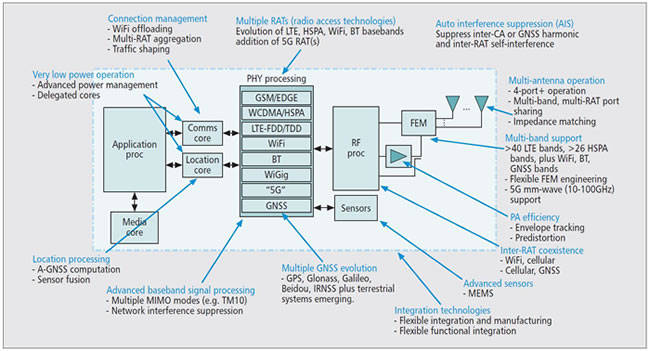
Some proponents have a vision of a cloud-based software solution for the protocol and hardware stack in 5G. For example, baseband samples of the RF signal can be passed to the cloud where the software receivers will demodulate and decode them. Yet others are proposing large MIMO configurations with hundreds of antennas to achieve the capacity gain. Millimeter wave technologies are also getting a lot of attention, and it is assumed that these technologies will play an important role in delivering high data rates in indoor applications. Universal filtered multi-carrier (UFMC) and filter bank multicarrier (FBMC) will probably be the selected modulation techniques, as opposed to basic OFDM. Use of software defined radios is also expected to grow. The following figure shows Intel’s concept of a 5G radio.
Although many ideas have been proposed and are being researched, the technology selection process is still in flux. A better understanding of the technology candidates for 5G will be possible when the first proposals are submitted later this year. As food for thought, one presentation at the November 2013 ETSI Summit by DG Connect, an EU based organization, suggests that 5G could offer the potential to be a full alternative to terrestrial TV broadcasting as a universal service by 2025. DG Connect is hoping to get 500 MHz or more of additional spectrum, possibly in the 6 GHz band or higher, for 5G operations. DG Connect’s presentation can be found here. At the ETSI Summit, DVB presented a vision that included tower overlay, LTE/broadcast time division multiplexing, device storage, and single frequency network (SFN) operation. The presentation was more of a business case for the existing 4G operators and TV broadcasters; it did not extend to meeting the overarching 5G vision, which includes perception of infinite capacity and a cloud based ecosystem. Last week, Japan’s NTT DoCoMo, a mobile operator, announced plans for running 5G experiments with six influential industry players: Alcatel-Lucent will experiment with candidate waveforms to support mobile broadband and Machine- to-Machine (M2M) communications in existing UHF bands; Fujitsu will test its resource scheduling algorithm for dense small cells with remote radio heads (RRH); NEC will experiment with its MIMO technologies in the 5 GHz band; Ericsson will conduct experiments on massive MIMO antennas in the 15 GHz band; Samsung will try out its millimeter-wave cellular prototypes and super-wideband hybrid beam-forming and beam tracking technologies in the 28 GHz band; Nokia will explore the potential of millimeter wave technology in 5G. DoCoMo will begin indoor trials with its partners this year and plans to perform outdoor field trials next year. The proposed 5G technologies have the potential to disrupt the traditional broadcast industry. How can broadcasting ensure its continued relevance when reliable Gbps wireless links becomes ubiquitous? When tactile internet becomes reliable enough to control cars on the roads, and when drivers will have internet access and time to consume rich media content in the car, what can broadcasters do to continue to effectively compete for advertising revenue? If technology for augmented reality matures enough to display holographic images, how can broadcasters leverage the new opportunity? Broadcasters need to answer these kinds of long horizon questions and monitor closely the 5G technology development process to be certain they remain valued participants in the communications-rich future. 2014 NAB
Broadcast Engineering Conference Proceedings FIMS to Present
Webinar on Business Benefits |
|

The May 19, 2014 Radio TechCheck is also available in an Adobe Acrobat file. Please click here to read the Adobe Acrobat version of Radio TechCheck |
|