|


|
Radio Highlights at the 2014 NAB Show Once again the radio broadcasting industry came together in Las Vegas for an exceptional week of networking, new product launches and equipment shopping, and education at the 2014 NAB Show held from April 5-10, 2014 at the Las Vegas Convention Center (LVCC). This week’s Radio TechCheck provides a look at some of the radio technology highlights from this year’s show. NextRadio Broadcasters had a chance to see and to learn more about the Emmis Communications-led hybrid radio initiative that has succeeded in getting over-the-air FM radio receivers into more than a million Sprint smartphones in the past year and continues to grow in popularity among consumers. NextRadio is the name of the “app” that is now included with virtually all Sprint smartphones (and available at the Google Play store) and provides access to the FM “chip” in these phones, enabling an enhanced radio listening experience.
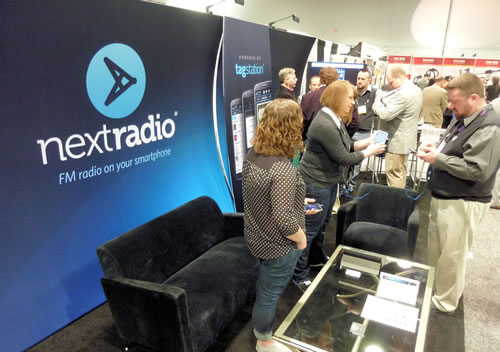
NextRadio had an exhibit in the LVCC central hall (shown in the photo here) where broadcasters could see a variety of phones running the NextRadio app and learn about Emmis’ TagStation technology which help broadcasters provide a vibrant and interactive hybrid radio experience to listeners. NextRadio was also a topic at a session at this year’s NAB
Broadcast Management Conference entitled “Hybrid Radio:
Making it Happen at Your Station,” which featured Paul
Brenner, Senior VP and CTO of Emmis Communications, Eric Williams,
Product Manager, Sprint, Kevin Gage, NAB Executive VP and CTO and
head of NAB Labs, Scott Burnell , Global Lead, Business Development
& Partner Management, Ford Motor Company, Joseph D'Angelo, SVP,
Broadcast Programs and Services, iBiquity Digital, Paul Shulins,
Director of Technical Operations, Greater Media Boston, and Tim
Clarke, Director of Digital Audience, Cox Media Group. An audio
and Powerpoint slide recording of this session is available for
purchase online from NAB at http://www.mediastoreonline.com/nabshow/index.php.
For more information about NextRadio, visit the TagStation web site
at http://tagstation.com/. NRSC Adopts Updated Guideline Document Four meetings of the National Radio Systems Committee (NRSC) were held in conjunction with this year’s Show. The NRSC is a technical standards-setting organization for the radio broadcasting industry co-sponsored by NAB and the Consumer Electronics Association (CEA). Milford Smith, Vice President Radio Engineering with Greater Media is the chairman of the NRSC; currently there are three active subcommittees – the AM and FM Analog Broadcasting (AFAB) Subcommittee, co-chaired by Gary Kline, SVP Corporate Director of Engineering & IT with Cumulus Media and Stan Salek, Senior Engineer with the broadcast engineering consulting firm of Hammett & Edison; the Digital Radio Broadcasting (DRB) Subcommittee, chaired by Andy Laird, VP and CTO, the Journal Broadcast Group; and the Radio Broadcast Data System (RBDS) Subcommittee, chaired by Dan Mansergh, Director of Engineering, KQED Public Radio. Shown in the photo below is the NRSC full Committee in session in Ballroom E of the Las Vegas Hotel and Casino.
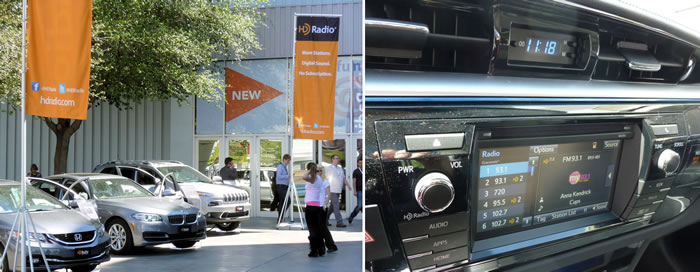
At this year’s RBDS meeting the group adopted an updated NRSC Guideline that focuses on recommendations for broadcasters and receiver manufacturers in the use of the Radio Data System (RDS) data broadcasting technology. NRSC-G300-A, RDS Usage Guideline, approximately seventy pages in length, adds significant additional information to the original document that focuses on emergency alerting using the RDS subcarrier. This updated Guideline will be available free-of-charge on the NRSC's website following a final, procedural review which will take approximately two weeks. Additional information about the NRSC, including information on becoming a member, is also available on the website. HD Radio Exhibit Highlights Automotive Receivers iBiquity Digital Corporation is the developer of HD Radio technology and hosted both an indoor and outdoor exhibit at this year’s show. Outside, a number of new cars were on display featuring factory-installed HD Radio receivers, serving as an example of the broad auto industry support this technology now enjoys. Shown in the photos below are models from Honda, BMW and Jeep (at left), and at right, an example of the user interface in a 2014 model year Toyota Corolla, including the “Artist Experience” graphical display.
During the Show, iBiquity announced that numerous automakers are shipping vehicles equipped with HD Radio Technology across North America. Ford, Toyota, GMC, Chevrolet, Buick, Jeep, Dodge, Mazda, Mercedes-Benz, Infiniti, Lincoln, Mitsubishi, and Ram now have vehicles at dealerships in the U.S., Mexico, and Canada offering the expanded audio features of digital AM and FM broadcasts delivered with HD Radio technology. iBiquity was also offering additional details about the adoption of HD Radio technology in Mexico, where it was approved as the digital radio standard in 2011, and in Canada. According to iBiquity, there are 13 stations broadcasting with HD Radio technology in Mexico City and 25 additional stations outside of the capital city in other areas of the country. iBiquity stated that nearly 30% of the Mexican population has access to an HD Radio broadcast with more broadcasters planning to support the digital rollout in the future. iBiquity reported that Canada is currently evaluating HD Radio technology with many of its border cities already having access to HD Radio broadcasts from the US. For additional information visit http://hdradio.com/. DaySequerra Debuts Diversity Delay Device
The DaySequerra M4DDC Diversity Delay Control is
a purpose-built, 1-RU, stand-alone AM or FM solution and runs DaySequerra’s
new proprietary “TimeLock” algorithm which, according
to DaySequerra, will automatically maintain perfect time and audio
level alignment of the HD Radio MPS and HD-1 audio streams. As discussed in the DaySequerra brochure, here’s how a broadcaster would utilize this device: in AM and FM installations that use an audio processor’s AES output to drive the MPS stream, the broadcaster sets all other delays in the MPS stream to zero and provides the MPS audio feed from the air processor into the M4DDC. The M4DDC then serves as the “master” delay, and the TimeLock algorithm will delay the MPS until it’s aligned with HD-1 (the main channel digital audio signal). In FM installations that use an audio processor’s composite clipper output to drive the MPS stream, the MPS stream delay in the audio processor is set to 10 seconds. The HD-1 (main channel digital audio) stream from the air processor is provided to the input of the M4DDC; the M4DDC’s TimeLock algorithm will delay HD-1 until it’s coincident with the MPS audio stream. Out-of-tolerance conditions can be reported via email, a built-in webserver using any browser on your network, and 5 rear panel alarm tallies. For more information visit the DaySequerra web site. |
|
|
The April 21, 2014 Radio TechCheck is also available in an Adobe Acrobat file. Please click here to read the Adobe Acrobat version of Radio TechCheck |
|
 Broadcasters
had a chance to see and to learn more about the Emmis Communications-led
hybrid radio initiative that has succeeded in getting over-the-air
FM radio receivers into more than a million Sprint smartphones in
the past year and continues to grow in popularity among consumers.
NextRadio is the name of the “app” that is now included
with virtually all Sprint smartphones (and available at the Google
Play store) and provides access to the FM “chip” in these
phones, enabling an enhanced radio listening experience.
Broadcasters
had a chance to see and to learn more about the Emmis Communications-led
hybrid radio initiative that has succeeded in getting over-the-air
FM radio receivers into more than a million Sprint smartphones in
the past year and continues to grow in popularity among consumers.
NextRadio is the name of the “app” that is now included
with virtually all Sprint smartphones (and available at the Google
Play store) and provides access to the FM “chip” in these
phones, enabling an enhanced radio listening experience.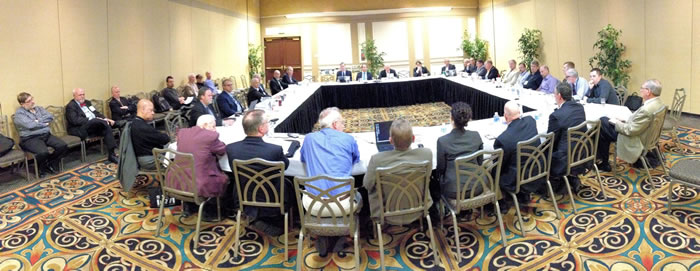
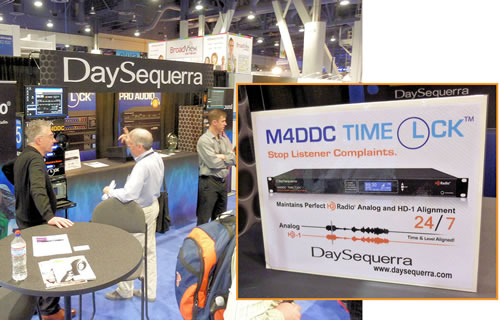 Broadcasters
who are operating in HD Radio hybrid (analog and digital) mode need
to continuously monitor and adjust the relative timing and level
of the analog and digital audio signals, so that when a consumer’s
receiver “blends” between analog and digital audio the
effect is a seamless and undistracting transition. This has proven
to be more difficult than it sounds, in part because there has not
been an automated solution to this monitoring problem. At this year’s
NAB Show, broadcast equipment manufacturer DaySequerra was displaying
a prototype of a new device, the M4DDC Diversity Delay Control (shown
in the photo), which promises to address this need.
Broadcasters
who are operating in HD Radio hybrid (analog and digital) mode need
to continuously monitor and adjust the relative timing and level
of the analog and digital audio signals, so that when a consumer’s
receiver “blends” between analog and digital audio the
effect is a seamless and undistracting transition. This has proven
to be more difficult than it sounds, in part because there has not
been an automated solution to this monitoring problem. At this year’s
NAB Show, broadcast equipment manufacturer DaySequerra was displaying
a prototype of a new device, the M4DDC Diversity Delay Control (shown
in the photo), which promises to address this need.