|
HTML5 Technology
Trends
HTML5 is the
latest revision of HTML (HyperText Markup Language), a markup language
to present content on IP devices such as computers, tablets and
cell phones. HTML5 is the product of collaboration
between World Wide Web Consortium (W3C) and the Web Hypertext Application
Technology Working Group (WHATWG). The goal of HTML5 is to support
multimedia content without plugins and thus making the platform
more ubiquitous.
Because HTML5
can be deployed across multiple platforms in the form of a browser,
only a single
source code needs to be developed per application. This not
only reduces the software development and maintenance cost, but
also shrinks the software development time and improves time to
market by leveraging matured development tools and a large community
of Web developers. HTML5 supports video and audio without needing
any plugins. W3C is currently working on adding broadcast- centric
capability such as EAS and closed captioning into HTML5. This all-encompassing
and platform-agnostic nature shows great promise for multimedia
delivery in the future, especially for mobile devices.
HTML5 has already achieved substantial market
penetration. According to a 2012 Appcelerator/IDC study, 78%
of the organizations were using HTML5. Today nearly 60% of mobile
app developers are interested in HTML5 development. Figure 1 shows
that general public’s interest in HTML5 has trumped ActionScript,
the programming language for Adobe Flash. All the major new browsers
support HTML5 today. It is estimated that 1 billion HTML5 enabled
devices will be sold in 2013. HTML5 is being incorporated into major
interactive TV standards such as HbbTV and OIPF "Hybridcast".
The performance of HTML5 will keep improving with the improvement
of JavaScript performance. Gartner Inc., an information technology
research and advisory firm, predicts that HTML5 will be the "go-to
enterprise
application development tool in 2014".
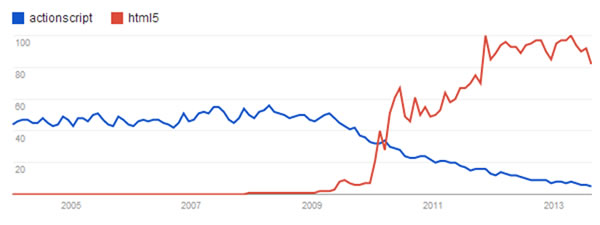
Figure 1: HTML5
trumps Adobe’s ActionScript (source http://www.html5canvastutorials.com/articles/web-graphics-trends-in-2013/)
Trends
show that HTML5 will gain steam with the gaming industry, which
will exploit the multimedia and graphics integration capability.
Blogging tools like WordPress may likely benefit from cleaner markup
functionality. Interactive infographics, a way to interact with
data to enhance user experience, could also become more popular
in the future. HTML5's enhanced Responsive Web Design feature, which
makes a Web page more readable on smaller screens, is also predicted
to be widely adopted.
Despite all the promise, HTML5 has run into some snags. Technology
trendsetters like Facebook,
LinkedIn,
and Netflix
have recently adopted native coding instead of HTML5. These companies
argue that the native coding can better exploit the hardware features
of target devices and thereby enhance the user experience. Apple
is also not promoting HTML5 because its strategically important
app store sells native language- based-apps.
On the other hand, media companies and news organizations are emerging
as leaders of HTML5 adoption. HTML5 offers them the promise of reaching
every potential viewer on every hardware platform with uniformly
authored multimedia content, and without the need to develop and
support platform-specific apps. The European Hybrid Broadcast and
Broadband TV (HbbTV) standard should also help drive the HTML5 adoption.
Many technologists are predicting that HTML5 will be the future
of both mobile devices and TVs.
|