|



|
SMPTE Symposium Brings Ultra HD Into Sharper Focus On October 21, the Society of Motion Picture and Television Engineers (SMPTE) held its annual Symposium in Hollywood, Calif. This year’s topic was “Next Generation Imaging Formats – More, Better and Faster Pixels,” and it took a detailed look at the current state of Ultra High-Definition (UHD) television. For the first time, the annual Symposium included two separate tracks–one technical and one business-related. (The technical track’s program chair was NAB’s Skip Pizzi, while the business track was chaired by Chris Chinnock of Insight Media.)
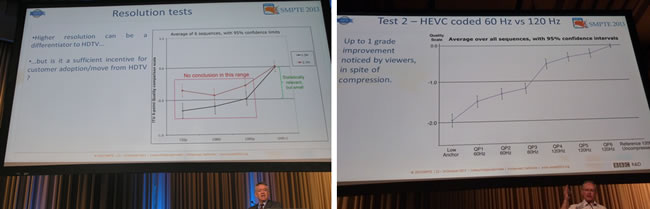
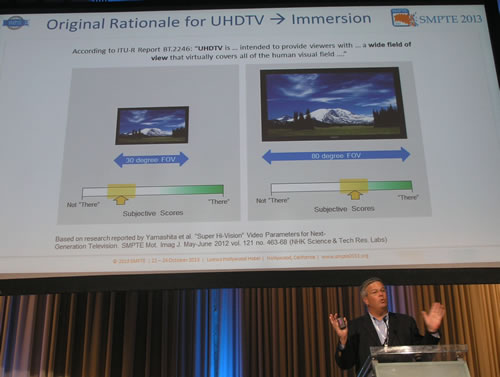
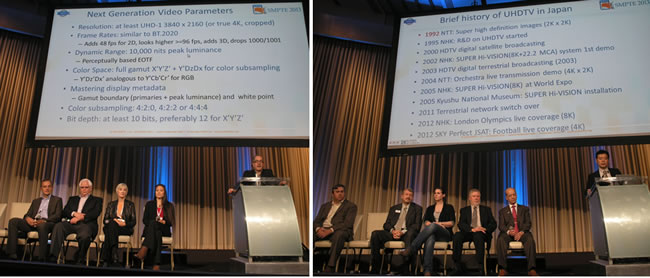
The day-long technical track program considered a range of issues, brought up to the minute and with an international scope by numerous expert presenters. A key takeaway from the sessions was that UHD is about far more than “4K,” the title that’s been ascribed to early products in the space–referring to the approximate number of pixels per line in the current 3840 x 2160 format–but more properly known as “UHD-1.” In fact, several presenters showed how such spatial resolution (i.e., “more pixels”) may in fact be one of the least important improvements that UHD brings to HDTV, since it is only noticeable on very large screens or with very close viewing. Other elements being considered for UHD formats include greater digital video bit depth, improved color subsampling (“better pixels”), and higher frame rates (“faster pixels”); all of these areas were thoroughly explored during the Symposium. The “8K” format, pioneered by NHK as Super Hi-Vision, and referred to generally as “UHD-2,” was also discussed. While acknowledging the importance of faster and better pixels, the NHK representative stressed that high pixel count remains critical for immersive viewing, which NHK believes is a key motivator for UHD. Others felt that the behavioral shift required for users to view TV screens at such close distances would not likely become a mainstream activity.
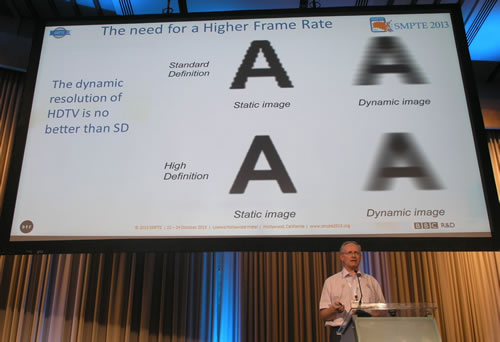
Following a deep tutorial on human visual perception that established a context for improving television presentation, credible research was presented showing how higher frame rates (e.g., 96, 100, 120, 200 and 240 frames per second) had significantly greater positive impact in subjective viewing tests than did spatial resolution, with 100 to 120 fps seeming to occupy a sweet spot.
The importance of increased luminance dynamic range and higher color resolution was also discussed, and while opinions varied somewhat, it appeared that 12-bit resolution might be an appropriate target for UHD formats. There were calls for replacing traditional gamma curves (which were developed in the era of CRT displays) with a new electro-optical transfer function (EOTF), perhaps one based on human perception.
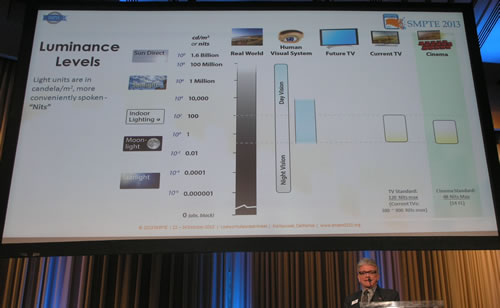
Regarding luminance, several presenters showed how short current television falls from the dynamic range of human perception and natural light, and suggestions were made for how much more of this dynamic range might be included in a UHD format. (To this, one attendee commented–not wholly facetiously–that we might be opening ourselves up for a video equivalent of the CALM Act in the future, whereby excessive brightness shifts between program segments might be outlawed. Another presenter donned sunglasses to make the point that the full dynamic range of natural light need not be represented by television.)
Wider color gamuts were also considered (another part of the “better pixels” discussion), and this appears to be perhaps the least settled issue at present, with a range of opinions on how to proceed. A major point of contention is whether to move from the gamut specified for HDTV in ITU-R Recommendation BT.709 to the extended RGB color primaries recommended for UHD in BT.2020, or to move to XYZ primaries as proposed in the MovieLabs Specification for Next Generation Video. The interaction of color gamut and intensity was also presented, with the resulting “color volume” explained using animated three-dimensional graphs. The interaction of the three sectors of improvement (more, better and faster) was also discussed, during which it was shown, for example, how perception of flicker may increase with the larger screens enabled by higher resolutions, and how higher video dynamic range may also require faster frame rates to avoid perception of other temporal artifacts. Updates were presented on the current state of UHD in the content creation, distribution and consumption sectors, delivered by representatives of the Hollywood studios, U.S. and international broadcasters, and consumer electronics manufacturers, respectively.
The current state of upconversion from HD to UHD (and downconversion from UHD to HD and SD) was covered, as well, with a key takeaway being that it is easier to up- and down-convert HD to/from UHD than it was to convert SD and NTSC to/from HD.
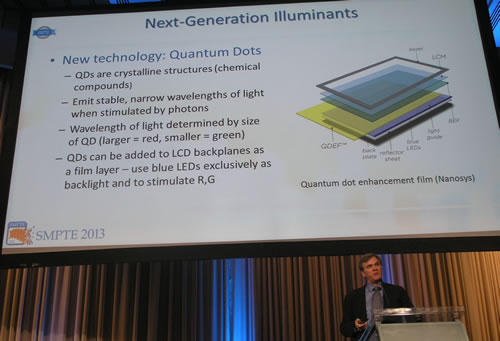
The Symposium also included a demo room where more than a dozen separate UHD presentations were shown, on what was thought to be the most 4K screens ever assembled in a single venue at any industry event to date. The demo room compared native UHD content to upconverted HD content, showed HEVC and AVC coding of UHD at a range of practical bit rates, and allowed attendees to see and interact with various UHD production tools operating live. SMPTE organizers and attendees alike seemed pleased with the turnout (a record-setting attendance) and the quality of the content presented. More information, can be found here.
|
|||||||||||||||
|
The November 4, 2013 TV TechCheck is also available in an Adobe Acrobat file. Please click here to read the Adobe Acrobat version of TV TechCheck |
|
||||||||||||||