|



|
HDMI 2.0 and Other Announcements Help Move Ultra HDTV Forward Ultra HDTV (of the 4K variety, 3840 X 2160 pixels) has been making a lot of news lately, with a variety of sets available to consumers from multiple manufacturers and prices falling (and likely to continue falling). Several Ultra HDTV announcements last week provided evidence that the remaining marketplace challenges of how to get 4K content to those sets will be eventually solved.
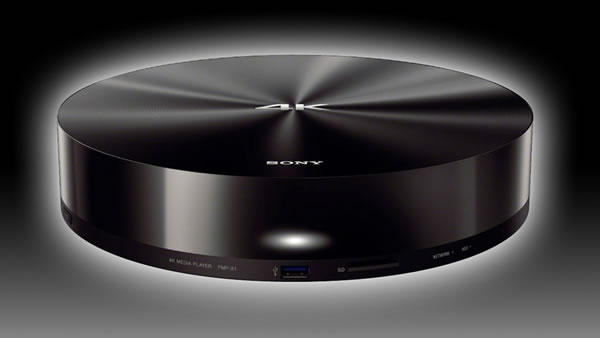
At the IFA show, Panasonic became the first manufacturer to announce an HDMI 2.0- enabled Ultra HDTV. The WT600 65” Ultra HDTV is now available for pre-order and will be available in mid-October at an MSRP of $6,000. As far as existing sets go, at least some manufacturers had anticipated the 2.0 specification and developed upgrade plans for their products. For example, Sony has indicated its Ultra HD sets will support HDMI 2.0 via a firmware update to be available over the Internet by the end of the year. Taking a different approach, Samsung has said that its line of Ultra HDTVs will be updatable via their modular Evolution Kit. HDMI 2.0 is a specification by the HDMI Forum Inc. The HDMI Forum is a non-profit corporation founded in 2011 by HDMI’s founders (Hitachi, Matsushita, Philips, Silicon Image, Sony, Thomson and Toshiba) and will be the venue where all future versions of the HDMI specification are developed. The HDMI Forum currently has over 80 members from the PC, CE and semiconductor industries. HDMI 2.0 is the first specification produced by the HDMI Forum. As an initial method of solving Ultra HD’s program delivery challenge, Sony Electronics announced the launch of their Video Unlimited 4K service last week. Over 70 movies and TV shows are now available for download to the Sony FMP-X1 Ultra HD Media Player, announced earlier this year and pictured below. Circular in shape with an approximate 10” diameter and height of 2”, the 4K media player is a stylishly distinctive TV accessory. With its 2TB hard drive the FMP-X1 can hold approximately 45 feature films, although it is only compatible with Sony 4K HDTVs and will not work with other brands.
Ultra HDTV is still in its infancy, and its ultimate degree of marketplace success remains a question. However, with large screen sizes and close-in viewing, there is little argument that the rendition of reality by an Ultra HDTV can be quite compelling. As more content becomes available for Ultra HDTV viewing, consumer behavior will be an important indicator of its long term acceptance and adoption. For more information about HDMI 2.0 see www.hdmiforum.org and www.hdmi.org. Only 3 Weeks
Left until the NAB\SBE Satellite Uplink Operators Workshop
There are only three weeks left to register to attend the NAB\SBE Satellite Uplink Operators Workshop. The workshop will be held at NAB headquarters in Washington, DC September 30 – October 3, 2013. The Workshop will include:
Don’t miss your chance to attend the workshop. For registration and additional information, contact NAB Technology at 202-429-5338 or click here. September is National Preparedness Month National Preparedness
Month is held each September and is designed to encourage Americans
to take simple steps to prepare for emergencies in their homes,
businesses, and communities. This year marks the ninth consecutive
year that NAB Member Benefit Program Partner Agility
Recovery and the U.S. Small Business Administration have worked
together to bring awareness and insights to business leaders, with
this year’s theme being “Be The Hero,” as determined
by the Department of Homeland Security's Ready Campaign and Citizen
Corps. Nominations Now Open for Women in Technology Awards TVNewsCheck has opened nominations for the 2014 Women in Technology Awards. Presented each year at the National Association of Broadcasters Convention, the Women in Technology Leadership Award recognizes women who have contributed significantly toward advancing their industry technologically. The Technology Women to Watch Awards shine a spotlight on women in radio, TV and digital who show significant promise of advancing their industry technologically. Both awards support the National Association of Broadcasters Education Foundation’s Technology Apprenticeship Program, which places young engineers who are women or people of color in broadcast industry internships. To nominate a colleague for the 2014 Women in Technology Leadership or Technology Women to Watch Award, please download a ballot here or call Kathy Haley, publisher, at 484 412 8297. |
|||
|
The September 9, 2013 TV TechCheck is also available in an Adobe Acrobat file. Please click here to read the Adobe Acrobat version of TV TechCheck.
|
|
||
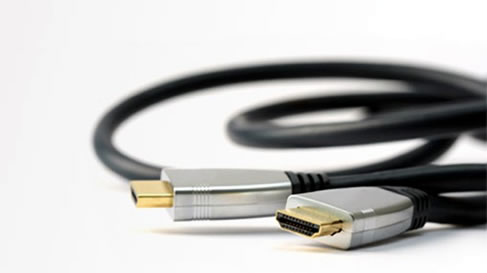 One
of the major impediments to a practical end-to-end Ultra HD service
has been lack of a method for getting signals actually into the
sets. The announcement of Version 2.0 of the HDMI specification
last week at the IFA consumer electronics trade show in Berlin is
thus a major step forward, increasing the maximum data throughput
of the HDMI digital interface from 10.2 Gbps to 18 Gbps. First introduced
over a decade ago, HDMI (High Definition Multimedia Interface) has
become the secure interface of choice for device-to-device interconnection
of digital television signals in the home. Over 3 billion HDMI devices
have been shipped since the inception of the specification. The
19-pin HDMI connector functionality is shown below.
One
of the major impediments to a practical end-to-end Ultra HD service
has been lack of a method for getting signals actually into the
sets. The announcement of Version 2.0 of the HDMI specification
last week at the IFA consumer electronics trade show in Berlin is
thus a major step forward, increasing the maximum data throughput
of the HDMI digital interface from 10.2 Gbps to 18 Gbps. First introduced
over a decade ago, HDMI (High Definition Multimedia Interface) has
become the secure interface of choice for device-to-device interconnection
of digital television signals in the home. Over 3 billion HDMI devices
have been shipped since the inception of the specification. The
19-pin HDMI connector functionality is shown below. 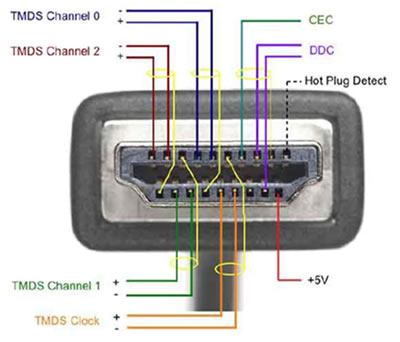 Video
(and multiplexed audio) signals are carried on the 3 lines labeled
TMDS (which stands for Transition Minimized Differential Signaling),
each of which has a maximum data rate of 6 Gbps. Prior to the 2.0
announcement last week, the HDMI 1.4 specification could support
Ultra HD spatial resolution of 3840 X 2160, but was limited to a
maximum temporal rate of 30 frames per second, making it suitable
for motion picture film transfers but not live television applications
such as sports. HDMI 2.0 allows full support of Ultra HD at 50/60
frames per second along with other new characteristics: up to 32
audio channels, up to 1536 kHz audio sampling frequency, support
for 21:9 aspect ratio pictures, and other new features. HDMI 2.0
is fully backward compatible with previous versions of HDMI and
uses the same connector.
Video
(and multiplexed audio) signals are carried on the 3 lines labeled
TMDS (which stands for Transition Minimized Differential Signaling),
each of which has a maximum data rate of 6 Gbps. Prior to the 2.0
announcement last week, the HDMI 1.4 specification could support
Ultra HD spatial resolution of 3840 X 2160, but was limited to a
maximum temporal rate of 30 frames per second, making it suitable
for motion picture film transfers but not live television applications
such as sports. HDMI 2.0 allows full support of Ultra HD at 50/60
frames per second along with other new characteristics: up to 32
audio channels, up to 1536 kHz audio sampling frequency, support
for 21:9 aspect ratio pictures, and other new features. HDMI 2.0
is fully backward compatible with previous versions of HDMI and
uses the same connector.