Facebook Facebook Facebook Facebook
April 16, 2013

NHK Demonstrates Super Hi-Vision Over-the-Air at 2013 NAB Show

At the 2013 NAB Show in Las Vegas, Nev., Japanese public-service broadcaster NHK presented a multi-staged demonstration of its Super Hi-Vision (SHV) system, which included a historic element - the first terrestrial transmission and reception of SHV anywhere in the world outside Japan.

The SHV test broadcasts included 8K video and 22.2-channel audio, and the experimental transmission over two 6 MHz TV channels marked the first North American terrestrial broadcast of video with image resolution above 4K. For this demo, NHK modified ISDB-T (the Japanese OFDM-based DTV transmission standard) transmitters and receivers for low-power use on U.S. TV channels. Operating under a Special Temporary Authorization (STA) obtained from the FCC by NAB, the transmissions used Channels 26 and 38 during the period of April 8-11, 2013. (Joe Snelson and Jack Smith of Meredith Corporation's Local Media Group in Las Vegas assisted with RF spectrum analysis and frequency coordination.)

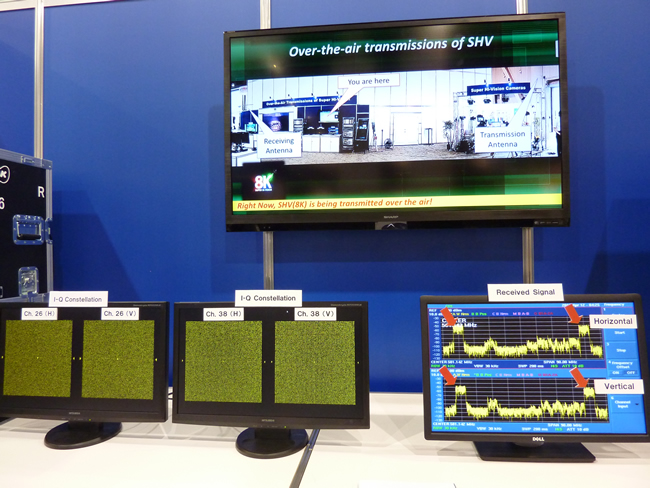
A portion of the NHK Super Hi-Vision demo at the 2013 NAB Show. The large (85") 8K video display at top shows over-the-air received signal. The content on the screen in this photo shows the layout of the booth, which calls out the location of the transmit and receive antennas, relative to the viewer's position in the booth. The 4096-QAM constellations are shown at lower left, and a real-time spectrum analysis is at lower right, showing the MIMO dual-polarized signals on Channels 26 and 38 used in the demo.

The transmit antenna was located at one edge of the NHK booth in the NAB Labs Futures Park (in the North Hall of the Las Vegas Convention Center), and the receive antenna was located near the other end of the booth, about 60 feet away (see diagram on monitor in photo above). The system used horizontal and vertical polarizations in a MIMO configuration on each of the two TV channels, and the two sets of polarizations were then multiplexed into a single H+V transmit antenna. Transmit power was 50 mW (TPO) on each MIMO signal.

The receiver also used a dual-polarized antenna, from which the two MIMO polarizations were demuxed from each of the two channels, and the four decoded signals ultimately recombined to present the SHV program.

Data on each of the four signal paths was encoded in 4096-QAM (see constellations shown in photo above) for a total throughput data rate of about 180 Mbps. The video codec used was ITU H.264 (MPEG-4 AVC), and NHK engineers on hand reported that they expect to soon implement the H.265 (MPEG HEVC) codec in the system, with the likely result of allowing 8K video and 22.2-channel audio to be transmitted over a single 6 MHz channel.

SHV is ultimately intended to support video at 7680 x 4320 resolution, with 12-bit samples, an extended color gamut and a 120 Hz frame rate. To date, however, most demonstrations have used a 60 Hz frame rate, and such was the case with the Las Vegas experimental transmission.

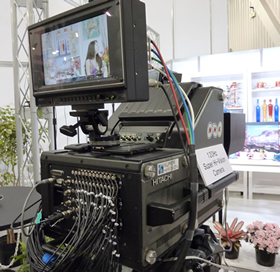
Nevertheless, elsewhere in the NHK booth, the first 120 Hz SHV studio camera was also demonstrated, using three 33-megapixel, 120 Hz CMOS image sensors. Its output was viewed on 4K and 2K monitors (a large 120 Hz 8K monitor has yet to be developed), and on the 2K monitors, a portion of the 120 Hz camera's image output was shown in both 120 Hz and 60 Hz versions. In that image segment, the motion blur performance of a synchronized, fast-scrolling video text image in the shot could be compared between 120 Hz and 60 Hz presentations, with the 120 Hz version showing substantially less blurring of the text. A portable 60 Hz SHV camera was also demonstrated, showing the practicality of SHV image acquisition.

The NHK booth also included an 80-seat presentation theater, where a 20 minute sampler of 60 Hz SHV content was projected on a 300 inch screen with full 22.2-channel sound. The demo included content from the 2012 London Olympics, Space Shuttle launches, recent footage from the 2013 Carnaval de Rio, and other material.

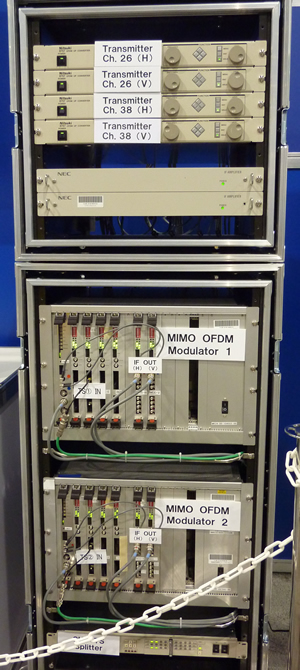
Transmitter equipment rack for the over-the-air Super Hi-Vision demo.

Recently developed 120 Hz Super Hi-Vision studio camera.
Camera stage, including video monitor on table running a fast, lateral-scrolling image for comparison of motion blur performance on 60 and 120 Hz displays from 120 Hz camera.


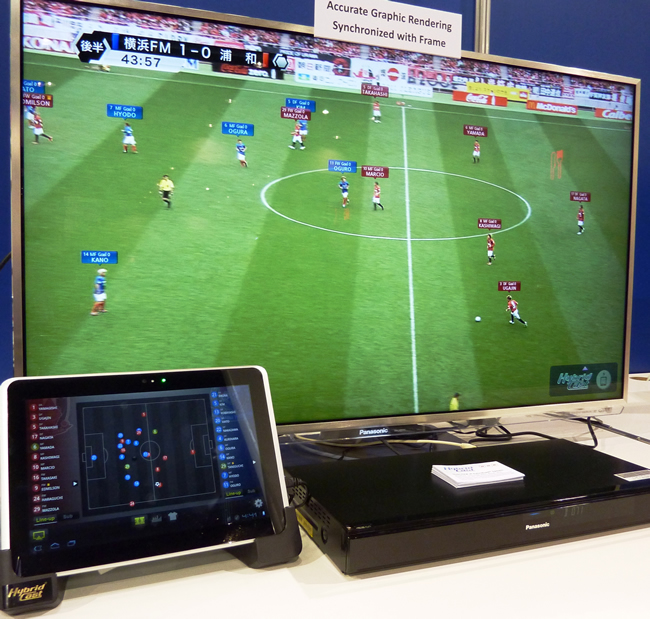
Another interesting demonstration showed the NHK Hybridcast service, a hybrid broadcast/broadband system intended to be included in the current ISDB-T system, but which can also be applied to other TV formats. One Hybridcast demo showed a soccer match in which the broadcast delivers the match video, and the broadband signal carries ID tags for the players (see photo below). The same broadband data was also displayed on a second screen application showing moving tags only in an overhead view, in which the players are indicated as colored dots on the display, with no video of the game included.

NHK Hybridcast demo shows tightly synchronized, moving player tags delivered by broadband, overlaid on video delivered by broadcast. Second-screen tablet at lower left shows player positions in synchronized game overview delivered by broadband only.

The entire NHK booth was well attended throughout the Show, and received high marks from attendees. The over-the-air demonstration ran continuously throughout the Show, with the received signal shown on an 85-inch 8K LCD display, and no failures reported.


The April 16, 2013 TV TechCheck is also available in an Adobe Acrobat file. Please click here to read the Adobe Acrobat version of TV TechCheck.