|


|
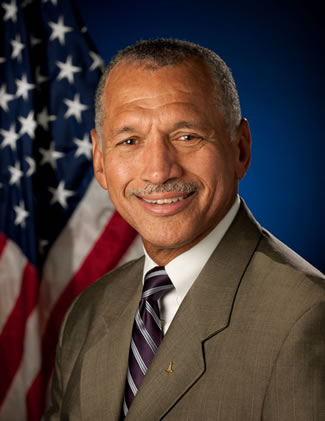
Bolden Beams In To Keynote Technology Luncheon The annual NAB Technology Luncheon will take place at the 2013 NAB Show in Las Vegas on Wednesday, April 10, 2013, 12:30 to 2:00 p.m., in the Paradise Ballroom of the Las Vegas Hotel. This year’s keynote speaker will be NASA Administrator Charles Bolden, who will make his presentation to the luncheon live via satellite from Washington, DC.
Bolden became
the twelfth administrator of NASA in July 2009, following a 34-year
career with the U.S. Marine Corps, from which he retired with the
rank of Major General. Selected as an astronaut by NASA in 1980,
Bolden was aboard the space shuttle for four missions between 1986
and 1994, commanding two of the missions. His flights included several
historic elements, including deployment of the Hubble Space Telescope
and the first joint U.S.-Russian shuttle mission. Prior to Bolden’s
nomination for the NASA Administrator’s job, he was chief executive
officer of a small business providing leadership, military and aerospace
consulting, and motivational speaking. The
2013 NAB Technology Luncheon is sponsored by Ustream, and will feature
presentation of the NAB Engineering Achievement Awards to Jay Adrick
of Harris Corporation and Frank Foti of the Telos Alliance, as well
as presentation of the NAB Service to Broadcast Engineering award
to Leonard J. Charles of Morgan Murphy Media. See the February 11,
2013 edition of TV TechCheck for more information about these awards. On February 4, the FCC released a Public Notice on updating the FCC’s OET Bulletin No. 69, “Longley-Rice Methodology for Evaluating TV Coverage and Interference.” Intended to be used in conjunction with the upcoming incentive auction process, the Public Notice proposes eight functional changes in the way the FCC calculates predicted coverage and interference for TV stations. These changes include the following: Population data-- The original 1997 DTV Table of Assignments used the 1990 Census. In the FCC’s 3rd Periodic Review on DTV in 2008, OET-69 was updated to use the 2000 Census. The Public Notice proposes to update to the 2010 Census. Terrain data-- OET-69 uses a 3 arc-second terrain database. The Public Notice says that this database has been superseded and is no longer maintained or supported by USGS. The Public Notice proposes updating to a 1 arc-second terrain database. Inaccurate data in FCC database-- The Public Notice states that the FCC CDBS in known to have various inaccurate entries and requests comment on methods to detect inaccuracies and correct them. Treatment of antenna beam tilt-- OET-69 inserts a fixed .75degrees of electrical antenna beam tilt and does not consider mechanical beam tilt. The Public Notice proposes using the value for electrical downtilt that is specified in the CDBS and proposes to continue ignoring mechanical beam tilt. Depression angle calculation-- OET-69 incorrectly calculates depression angle by using antenna height above ground instead of antenna height above sea level. The Public Notice proposes to fix this error. Precision of geographic coordinates—OET-69 truncates the precision of the location of Census Blocks to the nearest second. The Public Notice proposes to use the full precision of the Census Block location data (about .0004 seconds). Establishment of calculation (cell) grid—OET-69 calculates cell grids based on the individual coverage contour of each station. The Public Notice proposes to use a single, national calculation grid which would be common to all stations. Treatment of internal Longley-Rice warnings—OET-69 assumes coverage exists in cells that are “flagged” by the Longley-Rice algorithm. The Public Notice seeks comment on whether this assumption should be maintained or changed. Comments on the Public Notice were due to the FCC on March 21. NAB’s position on the Public Notice was made known early in a February 8 ex parte letter from Rick Kaplan, NAB EVP, Strategic Planning, in which NAB pointed out three central issues: 1)
Congress plainly intended the Commission to apply OET-69 as it existed
at the time of enactment of legislation authorizing the incentive
auction process;
NAB joined with the ABC, CBS, Fox and NBC networks and their affiliate organizations to amplify these points in joint comments filed with the FCC last week. In addition, the filing presents the results of engineering studies run by NAB to analyze the individual and cumulative effect of the changes identified in the Public Notice on the predicted coverage area and population served for all existing full power and Class A stations. For instance, the test results indicate that approximately 61% of all full power and Class A stations will lose predicted coverage area and population served when all of the proposed changes are applied. Reply comments on this Public Notice in ET Docket 13-26 and GN Docket 12-268 are due on April 5, 2013. The FCC Public Notice can be found here. NAB’s February 8 ex parte letter can be accessed here. NAB’s comments can be found here. |
|||
|
|
|
||