|



|
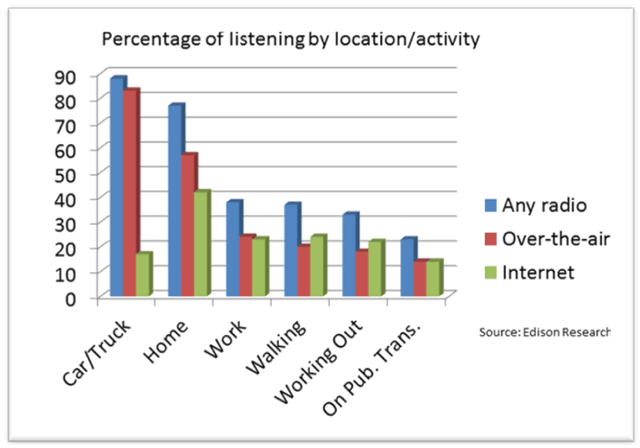
Study Looks at Listening Trends for Internet and Broadcast Radio On September 24, market research firm Edison Research released a report on Internet radio usage called The New Mainstream: 2013. Produced in partnership with streaming service providers Pandora, Spotify and TuneIn, Edison Research conducted a national online survey of over 3,000 people aged 12 and older for the study in July 2013. While primarily an analysis of Internet radio usage, the study offers insight into questions that concern over-the-air broadcasters, such as how pervasive Internet radio has become, whether time listening to Internet radio reduces the time spent listening to over-the-air radio and how Internet radio listening compares to over-the-air radio in various radio consumption contexts. Overall, the study showed that 90 percent of age 12+ consumers listen to AM/FM radio while 53% listen to Internet radio. A breakdown of usage by location and activity is shown in the following chart.
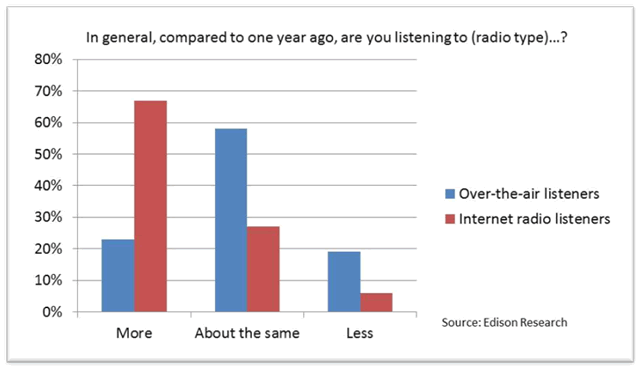
As this chart shows, the percentage of listening to any kind of radio while in a car or truck and at home is very high, while listening while at work, walking and other activities are significant but not as popular as the first two categories. It is also immediately apparent that broadcast radio currently dominates in the car/truck category, and beats Internet radio listening at home as well. In other contexts, Internet radio and broadcast radio listening are fairly equally prevalent. The trend in the type of radio listening over the past year is also insightful, as shown in the chart below.
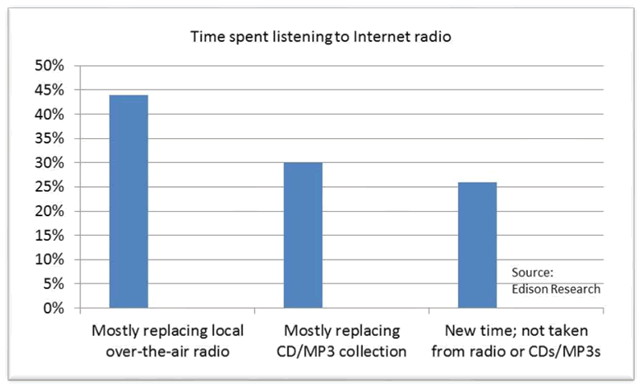
Note that over half of listeners are listening to broadcast radio the same amont as they did last year and almost a quarter are listening more. Another question of interest to broadcasters is whether the time for listening to Internet radio comes from time previously used for listening to over-the-air radio. This question was also part of the survey and results are shown in the chart below.
The data from the chart shows that less than half of listeners reported that Internet radio listening time was replacing time previously used for listening to over-the-air radio. Of particular interest is that a quarter of the listeners reported that Internet radio listening was not reducing their listening time with either broadcast radio or CD/MP3s. It is no exaggeration any more to describe Internet radio as being mainstream. For the three sponsors of the Mainstream: 2013 study, Pandora has about 72 million active listeners, while Spotify has about 24 million and TuneIn has about 40 million. Others such as Clear Channel’s I Heart Radio streaming service also compete vigorously in this space as well as a number of others. New streaming media competitors are also emerging: the Edison Research study was released a week after the September 18 launch of Apple’s iOS 7 operating system for the iPhone, with the iPhone 5S and 5C phones becoming available on September 20, products that introduced the new iTunes Radio feature. Apple announced that over 11 million unique listeners had tuned into iTunes Radio just one week after the launch, an indicator that perhaps there is still ample room for new competitors in streaming radio. Nonetheless, as the Edison Research study shows, broadcast radio competes well with Internet radio for listening time and continues to be the dominant form of radio being consumed. The full Mainstream: 2013 study from Edison Research can be found here. IEEE Broadcast
Symposium Takes Place This Week in San Diego |
|
|
The October
7, 2013 Radio TechCheck is also available in an
Adobe Acrobat file. Please click
here to read the Adobe Acrobat version of Radio TechCheck. |
|