|



|
WBCN All-digital AM IBOC Field Test Project
Unlike the hybrid AM IBOC system, the all-digital system has undergone very little testing (outside of that conducted by iBiquity when designing the system), and it has not been evaluated by the National Radio Systems Committee (NRSC). In 2012, CBS Radio approached NAB Labs and iBiquity, offering to make AM station WBCN available on a limited basis for all-digital AM IBOC testing, providing an opportunity to begin developing a contemporary test record that would help educate the industry as to the capabilities of all-digital operation, develop all-digital operational parameters, and provide information which could be eventually submitted to the FCC for the purposes of obtaining permanent authorization for all-digital service. DESCRIPTION OF FACILITIES - WBCN is a 10 kW daytime, 1 kW nighttime non-directional expanded-band facility that typically operates in HD Radio MA1 mode (hybrid AM IBOC). WBCN's main transmitter is a Harris DX-10 fed by a Harris Dexstar exciter. Under normal operating conditions the DX-10 is used for both day and night operation, however, WBCN also has a 1 kW Nautel transmitter available as a backup. TRANSMITTER CALIBRATION - it was necessary under this project to develop a procedure for setting the correct all-digital AM IBOC transmitter RF output level. Due to the limited peak capability of the DX-10 transmitter, an adjustment of power output was necessary to maintain maximum peak-to-average ratio (PAR) while avoiding clipping of the modulation peaks. Clipping results in excessive intermodulation distortion (IMD) products and potential non-compliance with the iBiquity MA3 mask. Prior to determining the proper RF output operating point for the system, the base impedance of the tower was verified as 71+j116 ohms at the carrier frequency. A Delta Electronics TCA-20 ammeter was used as the reference to determine actual power output. In order to enable the all-digital AM mode (MA3), Harris supplied updated Dexstar software, IRSS version 4.4.7 (this was "pre-release" software developed especially for this project). The DX-10 transmitter was used for essentially all analog and digital testing modes to obtain the data for this project. The backup Nautel 1 kW transmitter, fed directly by an Orban Optimod audio processor, was used in some instances to provide the 1 kW analog signal. (The procedure established for setting the proper RF output to achieve maximum RMS power and MA3 mask compliance is described in the full paper; see below.) TEST RESULTS - MOBILE TESTING - once the transmitter was properly calibrated for operation in MA3 mode, an iBiquity test vehicle was driven along each test route to establish the digital point of failure (POF). Principal determination of all-digital signal reception and POF was done using an OEM Ford Sync HD Radio receiver that was factory-installed in a Ford Focus automobile and connected to the vehicle's built-in antenna. A custom data interface to this receiver was designed by iBiquity utilizing the auto's "I2C" data bus allowing for connection to a laptop computer. Note that principal determination of all-digital signal reception was done using this receiver/antenna combination since this most accurately represents an actual consumer experience.
The typical experience on each test route was that all-digital reception would be solid, with no "drop-outs," in strong signal areas near the transmit antenna, and it would stay solid with only an occasional drop-out until near the all-digital POF, at which point reception would fairly abruptly become intermittent and then be lost completely. Reception data collected from the Ford Sync receiver is illustrated in the figure shown here for daytime reception. (Nighttime mobile results, and daytime and nighttime indoor results were obtained as well, and are contained in the full paper.) This paper is included in its entirety in the 2013 NAB BEC Proceedings, available on-line from the NAB Store (www.nabstore.com). For additional conference information visit the NAB Show Web page at www.nabshow.com. Correction to April 29 article on Silicon Labs digital radio receiver IC: In identifying the size of the Silicon Labs Si468x IC in last week's Radio TechCheck, one of the dimensions of the WLCSP 62-ball package was incorrect. The correct size should have been 3.2 mm x 3.8 mm instead of 3.2 mm x 2.8 mm. Our apologies for the error. |
|
|
The May 6, 2013 Radio TechCheck is also available in an Adobe Acrobat file. Please click here to read the Adobe Acrobat version of Radio TechCheck.
|
|
 CBS
Radio AM station WBCN, 1660 kHz, Charlotte, NC, obtained an experimental
license from the FCC in late 2012 for operation in the iBiquity
in-band/on-channel (IBOC) HD Radio all-digital MA3 mode. A project
team consisting of
CBS
Radio AM station WBCN, 1660 kHz, Charlotte, NC, obtained an experimental
license from the FCC in late 2012 for operation in the iBiquity
in-band/on-channel (IBOC) HD Radio all-digital MA3 mode. A project
team consisting of 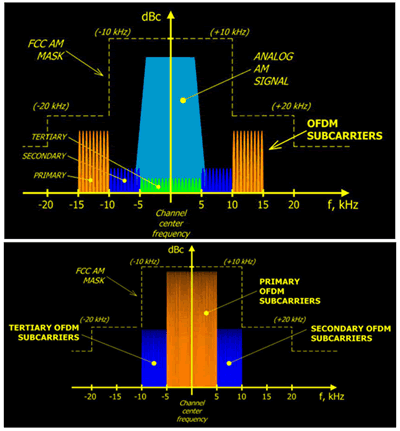 INTRODUCTION
- it has been contemplated that the transition to digital radio
using the HD Radio system could encompass two phases: the introduction
of digital radio services using the hybrid signal (upper spectrum
shown in figure), which would continue to allow for reception of
the main channel audio portion of the signal on legacy analog receivers,
and an eventual transition from the hybrid signal to the all-digital
signal (lower spectrum shown in figure), when there was sufficient
penetration of HD Radio receivers in the marketplace (~85%) so as
not to disenfranchise listeners. Use of the all-digital signal would
be advantageous because of its increased payload capacity and robustness,
but these advantages must be traded off against the loss of reception
by analog receivers, which are numerous.
INTRODUCTION
- it has been contemplated that the transition to digital radio
using the HD Radio system could encompass two phases: the introduction
of digital radio services using the hybrid signal (upper spectrum
shown in figure), which would continue to allow for reception of
the main channel audio portion of the signal on legacy analog receivers,
and an eventual transition from the hybrid signal to the all-digital
signal (lower spectrum shown in figure), when there was sufficient
penetration of HD Radio receivers in the marketplace (~85%) so as
not to disenfranchise listeners. Use of the all-digital signal would
be advantageous because of its increased payload capacity and robustness,
but these advantages must be traded off against the loss of reception
by analog receivers, which are numerous. Information
collected on the laptop computer was obtained from the OEM receiver
as well as a GPS receiver (connected via USB) and included time
(UTC), position (latitude and longitude), vehicle speed, receive
mode (all-digital enhanced, all-digital core, no reception), and
RF signal-to-noise ratio (SNR). Software was custom-designed by
iBiquity for AM HD Radio data collection.
Information
collected on the laptop computer was obtained from the OEM receiver
as well as a GPS receiver (connected via USB) and included time
(UTC), position (latitude and longitude), vehicle speed, receive
mode (all-digital enhanced, all-digital core, no reception), and
RF signal-to-noise ratio (SNR). Software was custom-designed by
iBiquity for AM HD Radio data collection.