|
Silicon Labs
Announces Single IC Supporting Global Digital Radio Standards
 On
April 22 2013, Silicon Labs, a supplier of mixed-signal integrated
circuits headquartered in Austin, Texas, announced a new family
of single chip digital radio receivers for consumer electronics
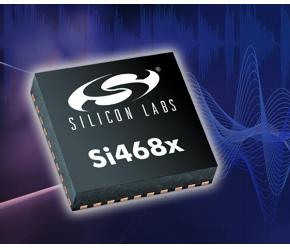
applications. This represents the industry’s first single-die
antenna-input-to-audio-output digital radio IC developed for the
global portable and consumer electronics markets. Specifically of
interest to U.S. broadcasters, the Si4682 supports HD Radio and
FM, while the Si4688 combines FM, HD Radio and DAB/DAB+. The Si468x
family offers a complete and cost-effective digital radio solution
integrating the RF tuner, baseband, and audio processing on a single
die. On
April 22 2013, Silicon Labs, a supplier of mixed-signal integrated
circuits headquartered in Austin, Texas, announced a new family
of single chip digital radio receivers for consumer electronics
applications. This represents the industry’s first single-die
antenna-input-to-audio-output digital radio IC developed for the
global portable and consumer electronics markets. Specifically of
interest to U.S. broadcasters, the Si4682 supports HD Radio and
FM, while the Si4688 combines FM, HD Radio and DAB/DAB+. The Si468x
family offers a complete and cost-effective digital radio solution
integrating the RF tuner, baseband, and audio processing on a single
die.
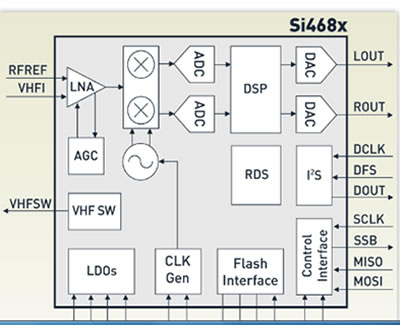 The
Si4682 is compatible with the iBiquity Digital and NRSC-5 standards
for FM In-Band-On-Channel (IBOC) digital radio broadcasting, integrating
digital channel demodulation and decoding functions, along with
audio decoding and IBOC analog-digital blend. The Si4682 can also
tune HD Radio reception to cover additional FM frequencies (76-108
MHz) for future IBOC adoption outside of North America. The IC additionally
supports IBOC multicasting, as well as the full-range of HD Radio
data services, such as PSD (Program Service Data), Artist Experience,
iTunes Tagging, Bookmark and real-time traffic, with the appropriate
external decoders. It also incorporates a full integrated decoder
for the European and North American version of RDS. The
Si4682 is compatible with the iBiquity Digital and NRSC-5 standards
for FM In-Band-On-Channel (IBOC) digital radio broadcasting, integrating
digital channel demodulation and decoding functions, along with
audio decoding and IBOC analog-digital blend. The Si4682 can also
tune HD Radio reception to cover additional FM frequencies (76-108
MHz) for future IBOC adoption outside of North America. The IC additionally
supports IBOC multicasting, as well as the full-range of HD Radio
data services, such as PSD (Program Service Data), Artist Experience,
iTunes Tagging, Bookmark and real-time traffic, with the appropriate
external decoders. It also incorporates a full integrated decoder
for the European and North American version of RDS.
The Si4688 has the same features as the Si682 and adds DAB/DAB+
capability in Band III (168-240 MHz) with an integrated source decoder
that supports MPEG Audio Layer 2 (DAB) and HE-AAC V2(DAB+). Another
member of the family, the Si4684, combines FM and DAB/DAB+ capability.
 The
Si468x single package family of receivers is available as a 7mm
x 7mm 48-pin QFN package and a much smaller WLCSP 62-ball package
3.2mm x 2.8 mm. Power consumption is less than 60 mW in analog FM
mode and less than 95 mW in HD Radio and DAB/DAB+ modes. Evaluation
kits are available and 10,000 quantity pricing begins at $5.62 each.
For more information see www.silabs.com. The
Si468x single package family of receivers is available as a 7mm
x 7mm 48-pin QFN package and a much smaller WLCSP 62-ball package
3.2mm x 2.8 mm. Power consumption is less than 60 mW in analog FM
mode and less than 95 mW in HD Radio and DAB/DAB+ modes. Evaluation
kits are available and 10,000 quantity pricing begins at $5.62 each.
For more information see www.silabs.com.
The availability of such a family of ICs covering global digital
radio standards suggests a belief by industry that the digital radio
market is growing around the world. Certainly this seems to be the
case in the U.S. Just prior to the NAB Show, iBiquity presented
significant growth statistics for HD Radio in the U.S. From their
April 5 press
release:
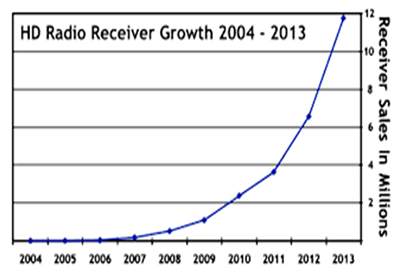
“HD Radio
receiver sales growth has accelerated, with a new radio sold every
6 seconds. Over 12 million HD Radio receivers have been sold, with
over 10 million factory-installed in new cars or auto aftermarket
units. This rapidly expanding installed base will help broadcast
radio compete with other new digital technologies for the drivers’
attention in the digital dashboard.
The numbers are impressive:
- 33 carmakers
now include factory-installed HD Radio Technology on 170 different
models
- 80 different
models include HD Radio Technology as standard equipment
- Over 3.4
million HD Radio-equipped cars were
sold in 2012
- 20% of all
new cars sold in 2012 included HD Radio Technology.”
Digital radio
in other parts of the world is also accelerating. For example, in
the UK, it was announced that 35.4% of new cars now come with digital
radio as standard according to data from automotive analysts CAP
and the Society of Motor Manufacturers and Traders (SMMT) released
on April 16 (an increase from 22.5% in Q1 2012 and from 9.9% in
Q1 2011). In Q1 2013 there were 215,000 cars sold with digital radio
as standard which represents 70% growth since Q1 2012.
The UK is considering eventually converting the radio broadcasting
service entirely to a digital platform. Over 15 million digital
radio sets have been sold and more than 41% of households own a
digital radio. The UK government has proposed a switchover criteria
as when 50 per cent of all listening is to digital, national DAB
coverage is comparable to FM, and local DAB reaches 90 per cent
of the population and all major roads. While several years ago a
target was suggested for a switchover date of 2015, the feasibility
of that date seems now in question. An update of the UK Government’s
Digital Radio Action Plan (version 8) was released in February 2013.
The February 2013 Action Plan hedges on the switchover date, but
promises a date certain for making a decision:
“The Government will, by the end of 2013, make a decision on
whether a radio switchover is in the best interests of broadcasters,
manufacturers, and most importantly consumers. This decision will
provide a clear statement of the Government’s intentions and
set out in detail how any future radio switchover would be funded
and implemented.” For more information, see https://www.gov.uk/government/publications/digital-radio-action-plan.
In any case,
digital radio is on the upswing, both in the U.S. and abroad. As
a result, we are likely to see more announcements for highly integrated
and cost effective IC solutions such as the recent product offering
by Silicon Labs.
|