|



|
Gage Challenges Broadcast Engineers in BEC Keynote
A standing-room only crowd at the Las Vegas Convention Center heard Gage address the many challenges faced by the industry. He suggested that the best way to confront these challenges is with a single voice as broadcasters. Gage presented NAB Labs as a venue for such convergence, pointing out how the Labs have already begun work on key areas that will present early or immediate benefit to broadcasters. He felt that the platform provided by NAB Labs can offer unique service and critical guidance to the industry. "One area in which we see strong promise is Hybrid Radio," Gage said. "We've defined and developed the technology, held meetings across the country and the world, brought previously separate communities together, and made investments to help this fledgling technology reach a tipping point." He continued, "We've also dug deep on the possibilities for AM radio's revitalization. Again we've studied the options and are taking steps to develop a multi-tiered strategy that will refresh the senior broadcast band, and give it new life in the digital age. We've run tests on all-digital IBOC for AM, which has never been broadly tested, with promising initial results." On the TV side of the industry, Gage commented,"We're looking at the next generation of technology that can make television even more compelling, flexible and entertaining. Through the efforts of our members in the NAB Labs Television Technology Committee, we are exploring just what a next-generation broadcast TV platform should include, and taking steps to test these assumptions in real-world environments." In the speech, Gage announced that NAB had joined a number of new standards development organizations, including the World Wide Web Consortium (W3C), the Alliance for Telecommunications Industry Solutions (ATIS), 3GPP, and DVB. He added that NAB was continuing its leadership position in ATSC and its ATSC 3.0 standards development, along with ongoing engagement in the Future of Broadcast Television (FoBTV) group. "Working with all of these bodies, and others we find appropriate in the future, will provide NAB Labs with the broadest possible vision of what's next for television technology, and what path makes the most sense for broadcasters to pursue," Gage said. He added, "We will seek out and explore other new affiliations – unorthodox though they may seem to be at first – as we establish our place within the "new normal" of the broadcasting business." Speaking about both Radio and TV, Gage noted the increasing importance of content discovery. To the question of how increasingly fragmented audiences find the programs they want, Gage noted that the environment has changed dramatically. "Traditionally this was easy – two knobs were all you needed: Tuning and Volume. Today it's much more complex and competitive, and becoming more so every day. We need to ensure that consumers can still find and enjoy broadcast content easily and quickly, on whatever device – or devices – they are using at the moment." He also cited robustness, scalability and localism as traditional strengths of broadcasting, stressing that these must be retained and improved upon by any future broadcast systems, and that the mobility of broadcasting must also be extended. "The audiences we serve are increasingly mobile," Gage observed, "and they want their media content along for the ride. Radio has long been a mobile service, but we can make it even more pervasive with its inclusion on more handheld devices, and its expanded service to vehicles through hybrid radio techniques. Meanwhile, as the first Mobile TV devices emerge, we are taking the first real steps toward adding mobility to our television services. Many more similar steps must follow." Gage challenged his listeners by reminding them, "Today's consumer is more technologically demanding and savvy than any other era, and with our new platforms we will have a new way to connect with them, to meet their requirements and exceed their expectations." He concluded with a collective call to action to broadcast technologists. "Our next generation broadcast systems will require greater flexibility and agility than in the past to meet unknown and ever changing market dynamics and competition. While challenging such fundamental tenets of broadcasting may raise some eyebrows, it is necessary, it is evolution, and we believe it is good business to revisit these long-held beliefs to see if they still have merit. But to do this, we will need to work together. Engage with us, and help us make NAB Labs a powerful vehicle for our mutual propulsion into the next generation of broadcasting." Gage's keynote speech opened the 2013 Broadcast Engineering Conference, which continued through Thursday, April 11.
|
|
|
|
|
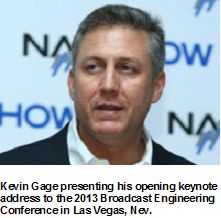 In
his keynote address at the 2013 Broadcast engineering Conference,
NAB Executive Vice President and Chief Technology Officer Kevin
Gage presented an overview of the first full year of work by NAB
Labs, and charted a course for the industry's future.
In
his keynote address at the 2013 Broadcast engineering Conference,
NAB Executive Vice President and Chief Technology Officer Kevin
Gage presented an overview of the first full year of work by NAB
Labs, and charted a course for the industry's future.