|
 |
 |

|
HD Radio in Smartphone Introduced at 2012 NAB Show
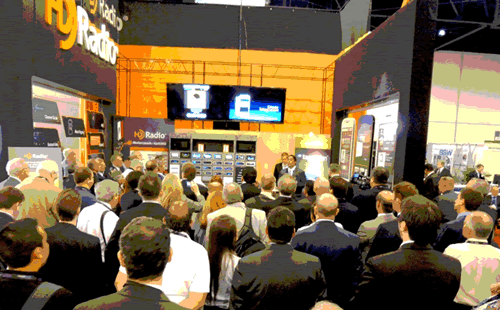
This technology is the result of an NAB Labs project (started in 2011 under the NAB FASTROAD technology advocacy program) with the project team of Emmis Interactive, iBiquity Digital Corporation and Intel, and project management by BIA/Kelsey. Created in 2012, NAB Labs is an NAB program that provides a platform for innovation, a venue for forging partnerships and testing new technology, and educational events to create awareness about over-the-air radio and television technology initiatives. Key pieces of the HD Radio smartphone "ecosystem" developed under this project were on display in the HD Radio booth all week in a live demonstration, including an Android smartphone with an embedded HD Radio receiver "chip" (by Intel), an HD Radio Android "app" (developed by Emmis Interactive) running on the smartphone, and the Emmis Interactive TagStation broadcast content insertion system. TagStation supports Artist Experience (the iBiquity-developed approach for broadcasting album art and station logo images to HD Radio receivers) and in addition, it can now deliver an enhanced HD Radio ad experience which leverages the power of the HD Radio data capability with a smartphone's data channel to deliver truly interactive advertising that features a variety of ad units including: couponing, geo-mapping, SMS texting integration, rich media, and many other advanced ad capabilities.
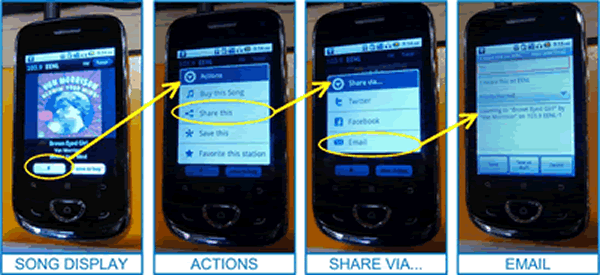
When the "action button" (highlighted by the yellow circle in the leftmost screenshot) is touched, various actions are made available, including the ability to share information about the song being listened to via Twitter, Facebook or email. The final screenshot in the sequence shows the email message which is automatically composed for this song, ready for sending to the recipient of the user's choice. Shown in the
second sequence are some interactive features that can be associated
with an advertisement using the HD Radio in smartphone receiver
and the Emmis Interactive TagStation. A Home Depot ad image is shown
in the leftmost image in the sequence Broadcasters who are interested in learning about the capabilities of the TagStation broadcast content insertion system can visit the Emmis Interactive website. Some of the other exciting HD Radio-related announcements at the Show included the following:
 about
the rollout of HD Radio in Mexico was revealed. Several of Mexico's
most important radio broadcasters have officially started transmissions
with HD Radio technology. Stations from Grupo Radio Imagen, Insituto
Mexicano de la Radio and Universidad Iberoamericana are among the
first to broadcast, and other major groups will gradually join in
Mexico City and the rest of the country. Additionally, the new Web
page www.hdradio.mx
has launched, created specifically for the Mexican market. about
the rollout of HD Radio in Mexico was revealed. Several of Mexico's
most important radio broadcasters have officially started transmissions
with HD Radio technology. Stations from Grupo Radio Imagen, Insituto
Mexicano de la Radio and Universidad Iberoamericana are among the
first to broadcast, and other major groups will gradually join in
Mexico City and the rest of the country. Additionally, the new Web
page www.hdradio.mx
has launched, created specifically for the Mexican market.
IEEE Broadcast Technology Society Issues Call for Papers
|
 The
The
 Many
of the interactive features provided by this HD Radio on smartphone
technology were being demonstrated in the booth and are depicted
in the smartphone screenshot sequences included here. The first
sequence shows how a user can share information about a song being
received on the phone's embedded HD Radio receiver chip. The leftmost
screenshot in this sequence shows the receiver "home page,"
including an Artist Experience album art image as well as the song
title and artist Program Associated Data (PAD), all being delivered
to the device using the data portion of the HD Radio signal.
Many
of the interactive features provided by this HD Radio on smartphone
technology were being demonstrated in the booth and are depicted
in the smartphone screenshot sequences included here. The first
sequence shows how a user can share information about a song being
received on the phone's embedded HD Radio receiver chip. The leftmost
screenshot in this sequence shows the receiver "home page,"
including an Artist Experience album art image as well as the song
title and artist Program Associated Data (PAD), all being delivered
to the device using the data portion of the HD Radio signal.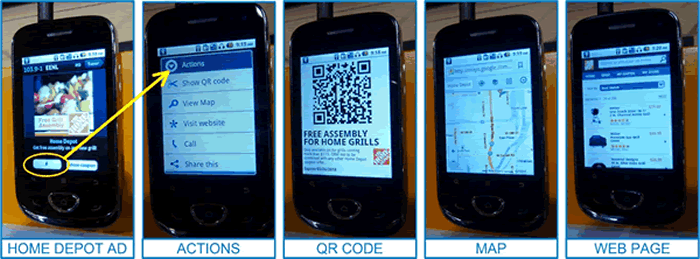 along
with the action button (highlighted by the yellow circle). This
ad image is synchronized with the audio portion of the ad being
broadcast over the HD Radio signal and is delivered using the HD
Radio data channel in a manner similar to that used to deliver album
art. In the second screenshot, the various action options for this
ad are shown, and the third, fourth and fifth screenshots show the
results for selecting QR code, view map and visit website, respectively.
along
with the action button (highlighted by the yellow circle). This
ad image is synchronized with the audio portion of the ad being
broadcast over the HD Radio signal and is delivered using the HD
Radio data channel in a manner similar to that used to deliver album
art. In the second screenshot, the various action options for this
ad are shown, and the third, fourth and fifth screenshots show the
results for selecting QR code, view map and visit website, respectively.
 A
Call for Papers has been issued for the 2012 IEEE Broadcast Symposium,
to be held October 17-19, 2012, in Alexandria, Va. The Symposium
Committee seeks timely and relevant technical papers relating
to all aspects of broadcast technology, in particular on the following
topics:
A
Call for Papers has been issued for the 2012 IEEE Broadcast Symposium,
to be held October 17-19, 2012, in Alexandria, Va. The Symposium
Committee seeks timely and relevant technical papers relating
to all aspects of broadcast technology, in particular on the following
topics:|
|


ADVERTISEMENTS