|
 |
 |

|
FM-Stereo
Transmission Using Single Sideband Suppressed Carrier ALTERNATE APPROACH - SINGLE SIDEBAND SUPPRESSED CARRIER
- an alternative approach for stereo transmission would be the use
of single sideband suppressed carrier (SSB-SC) as the mechanism
to carry to the L-R payload. Shown in the figure is the existing
method (DSB-SC, top image) and the alternative SSB-SC method (bottom
image). The lower sideband is chosen as it reduces the occupied
spectrum from 53 kHz down to 38 kHz. In order to support the correct
L+R/L-R matrixing in the receiver, the amplitude of the lower sideband
is increased by 6dB. This offers numerous benefits to the receiver
including: SSB-SC AND MODULATION PEAK CONTROL - implementing SSB-SC
can be accomplished using numerous techniques. The most common
method is through use of the Hilbert function, where a 90 degree
broadband phase shift is used to cancel the undesired sideband.
It can also be achieved using a Weaver modulator, or a low pass
filter set to critically limit the desired passband, and the undesired
sideband is removed through filtering. All of these methods provide
satisfactory SSB-SC operation, but there is a critical element
that must be considered - peak control of the overall multiplexed
signal. In each of the aforementioned SSB-SC methods, there will
be alteration to the phase relationship of the sideband signal.
This alone will generate overshoot to the multiplexed encoded
signal. It is paramount that SSB-SC modulation must not add any
overshoot to the signal, and it must not add any unwanted non-linear
components, in the form of audible overshoot peak limited harmonic
content, i.e., clipping by-products. The sonic performance of
the SSB-SC modulator must perform sonically, exactly the same
as the DSB-SC counterpart. Switching from DSB-SC mode to SSB-SC
should not change the resulting sound in stereo separation, audio
quality and peak control. REAL-WORLD ACTIVITY: IN THE FIELD AND IN THE LAB - As
of this writing, SSB-SC is on-the-air in multiple major markets
(under FCC experimental authority), and all users report a reduction
in perceived multipath. While most feedback is of the subjective
anecdotal variety, there has been some initial lab testing done
to determine, at the very least, if SSB-SC offers any degradation
to FM service. Using a multipath generator that offered repeatable
multipath profiles in a controlled environment, it was possible
to gather data from a receiver operating under an impaired signal.
This test indicated that SSB-SC offers no perceivable degradation
to the FM service signal. Mr. Foti will present this paper on Sunday, April 15, 2012 starting
at 10:30 a.m. in room S228 of the Las Vegas Convention Center.
It will also be included in its entirety in the 2012 NAB Broadcast
Engineering Conference Proceedings, on sale at the 2012 NAB Show
Store and available on-line (after the Show) from the NAB Store
(www.nabstore.com). Other
papers being presented during this session include the following: IEEE
Broadcast Technology Society Issues Call for Papers
The submission
deadline for abstracts is May 15, 2012. Visit http://bts.ieee.org/images/files/2012_IEEE_BS_Call_for_papers.pdf
for additional information. This Symposium is produced
by the IEEE Broadcast Technology
Society.
|
 As
codified in the FCC rules, FM stereo transmission uses double sideband
suppressed carrier (DSB-SC) within the multiplex baseband signal
as the means to transport the stereo sound field to the receiver.
This method, while robust and reliable, is prone to the effects
of multipath fading. A session at the upcoming NAB Broadcast Engineering
Conference (
As
codified in the FCC rules, FM stereo transmission uses double sideband
suppressed carrier (DSB-SC) within the multiplex baseband signal
as the means to transport the stereo sound field to the receiver.
This method, while robust and reliable, is prone to the effects
of multipath fading. A session at the upcoming NAB Broadcast Engineering
Conference (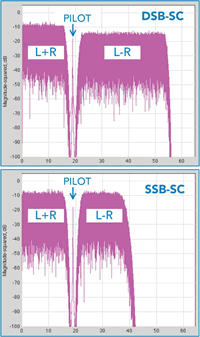 INTRODUCTION
- FM radio has a good fight on its hands. As a media transom to
the public, it battles a multitude of additional delivery services
like never before. The FM stereo system, as described above, has
worked quite well for 50 years, but not without challenges. Most
notable is multipath distortion, especially in areas of congested
buildings, hills and/or mountainous terrain. Also, radio broadcasters
have added incremental signals within the multiplexed spectra. Radio
Data System (RDS) services based at 57 kHz, as well as a 92 kHz
SCA can additionally occupy the signal. The modulation index of
the FM carrier is further reduced with each and every added signal,
thus increasing the sensitivity of multipath distortion in the receiver.
What can FM radio do, technically, to improve sonic performance
so a listener has less reason to abandon it as an outlet?
INTRODUCTION
- FM radio has a good fight on its hands. As a media transom to
the public, it battles a multitude of additional delivery services
like never before. The FM stereo system, as described above, has
worked quite well for 50 years, but not without challenges. Most
notable is multipath distortion, especially in areas of congested
buildings, hills and/or mountainous terrain. Also, radio broadcasters
have added incremental signals within the multiplexed spectra. Radio
Data System (RDS) services based at 57 kHz, as well as a 92 kHz
SCA can additionally occupy the signal. The modulation index of
the FM carrier is further reduced with each and every added signal,
thus increasing the sensitivity of multipath distortion in the receiver.
What can FM radio do, technically, to improve sonic performance
so a listener has less reason to abandon it as an outlet? A
Call for Papers has been issued for the 2012 IEEE Broadcast Symposium,
to be held October 17-19, 2012, in Alexandria, Va. The Symposium
Committee seeks timely and relevant technical papers relating
to all aspects of broadcast technology, in particular on the following
topics:
A
Call for Papers has been issued for the 2012 IEEE Broadcast Symposium,
to be held October 17-19, 2012, in Alexandria, Va. The Symposium
Committee seeks timely and relevant technical papers relating
to all aspects of broadcast technology, in particular on the following
topics:|
|




ADVERTISEMENTS