|
 |
 |

|
Avoiding Broadband/Broadcast Interference: A Tale of Two Countries On October 24
2012, over-the-air television in the United Kingdom became all-digital
when the last analog transmitter operating in Northern Ireland was
shut off, ending a phased-in cessation of analog broadcasting that
began in October 2007 and progressed steadily over the past five
years as different regions of the country were transitioned fully
to digital. The analog switch-off has freed up spectrum capacity
in the 800 MHz band, which will be used for 4G mobile services.
Known as "the digital dividend," these frequencies will
be auctioned by Ofcom, the UK"s regulatory agency, beginning
early in 2013. The solution offered by Ofcom was to form a new organization, funded by the 800 MHz mobile broadband service licensees, nominally called MitCo (a reference to mitigation of interference), which would manage the prevention of interference for existing DTV viewers. Beyond being an information and education source for consumers, MitCo would provide and/or install filters fitted for TV receivers to viewers thereby offering protection from the 800 MHz signals. £180 million (approximately $292 million) would be made available to MitCo by the 800 MHz licensees and MitCo would be monitored by an Oversight Board set up by the UK Government. On October 18,
the U.K.'s "big four" mobile phone operators - Everything
Everywhere (EE), Telefónica (owner of O2), Three and Vodafone
- stepped up to the challenge and announced that they have formed
a jointly-controlled company called Digital Mobile Spectrum Ltd
(DMSL), which will act as the Ofcom-proposed Mitco entity. DMSL
will be responsible for ensuring that consumers can continue to
receive clear Freeview DTV signals following the roll out of 4G
mobile services in the 800MHz spectrum band being planned for Spring
2013. It is anticipated that many viewers will be able to fit the
free supplied filters on their television sets themselves, but some
will require a visit from a knowledgeable installer. In any case,
a high priority has been established for protecting UK television
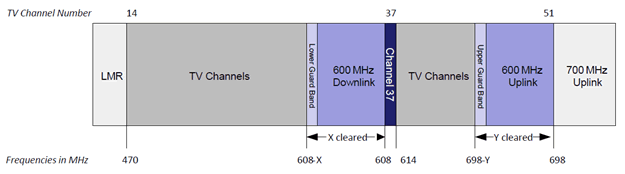
viewers from interference by mobile broadband transmitters. The FCC's "lead"
band plan (alternative band plans are also presented), as described
in the NPRM released by the FCC on October 2, is shown below: The amount of
spectrum made available is auction-dependent. The uplink spectrum
begins at channel 51 (698 MHz) and expands downward while the downlink
spectrum begins at channel 36 (608 MHz) and expands downward. Five
megahertz blocks are proposed for wireless broadband with channels
paired where possible. To mitigate broadband-broadcast interference,
6 megahertz guard bands between the auctioned spectrum and the broadcast
TV spectrum are proposed. These guard bands would also be available
for unlicensed use. Since the new service will be divided in 5 MHz
blocks and TV service is based on 6 MHz channels, there may be some
"left-over" spectrum, depending on how much spectrum is
ultimately cleared - the Commission proposes to add this extra spectrum
to the guard bands in order to align the blocks. The 205 pages of
the NPRM and statements from the FCC Commissioners can be downloaded
here.
Comments are due December 21, 2012 and reply comments are due February
19, 2013. |
|
The next TV TechCheck will be published on November 18, 2012. |


ADVERTISEMENTS