|
 |
 |

|
NDS “Fresco” Demonstration Envisions a Bold Future of Television On July 18 and 19, 2012, NAB hosted private demonstrations of the Fresco project for industry stakeholders at its headquarters in Washington DC. Fresco is a development of NDS, formerly a division of News Corp., now being acquired by Cisco Systems. The demo is not for a particular product, but rather is intended to present a conceptual (yet tangible) view of a possible future environment for television viewing. Like a number of science fiction books and movies have suggested (like the “TV Parlors” in Ray Bradbury’s Fahrenheit 451, or the video walls in Total Recall and Minority Report), consumers of tomorrow may have expansive video screens available, perhaps covering entire walls of their homes or workplaces. NDS and others feel that this future is not far away, given the progress in OLED development that could soon lead to large display arrays assembled from smaller elements. The OLED panels could be super-thin, frameless, and either transparent when off, or coupled with electrophoretic ink (“E-Ink”) panels – as used today in many e-book readers – to provide a static background pattern. “It could be like tiling your bathroom,” as NDS’s Simon Parnall described. Parnall, VP Technology for NDS’s UK office, presented the Fresco demos to various NAB staff, ATSC members and other television industry insiders. (The presentations were timed to coincide with quarterly ATSC face-to-face meetings in Washington, DC that week.) He showed how video screen size continues to grow, but now physical limits are being reached, such as the size of freight containers and even the door sizes of consumers’ homes. As a result, the continuing growth of conventional flat-screen displays will soon hit a plateau that can only be overcome via some radical change like the assembly of screens from smaller elements. Once this happens, Parnall predicts that other changes might rapidly occur. Primary among these is freedom from the boundaries of aspect ratio and display size that we have grown accustomed to since the dawn of TV. “At home I have a 42-inch display today, and I get 42-inches of everything – news, sport, drama, movies – and 42” of nothing sitting in the corner when it’s off,” Parnall said, adding that in the future we will understand that for visual content of different types and during different dayparts, “one size most definitely does not fit all.” Parnall and
his team at NDS have developed the project to help them, their customers,
and the industry at large, envision how content might be used in
such a display environment, which differs in several significant
ways from today. As Parnall outlined, such a future display would
be unobtrusive (i.e., blending into the background of the
room when quiescent), ultra high-definition (at least 4k),
immersive (i.e., more engaging than today’s screens
due to its size and occupied space around the viewer), and ambient.
By the latter, Parnall explained that such a display would “live
with the viewer or family in the home,” displaying items that
might today be presented by physical pictures on the wall, calendars,
clocks, magnetic notes posted on the fridge, and the like. The display
could also be used to present multiple simultaneous content elements
(from broadcast, broadband or in-home sources), sized and arranged
or the screen appropriately, or a single content element at a large
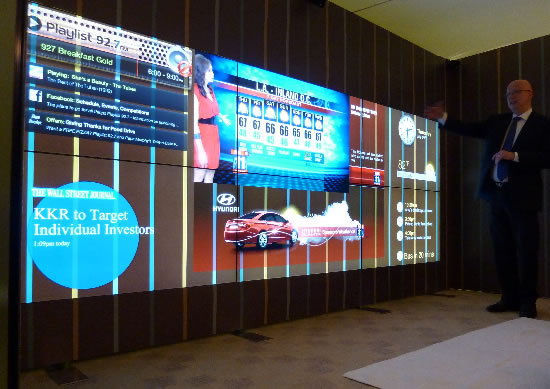
size – so called “full immersion.” (See photos showing
both options, below.)
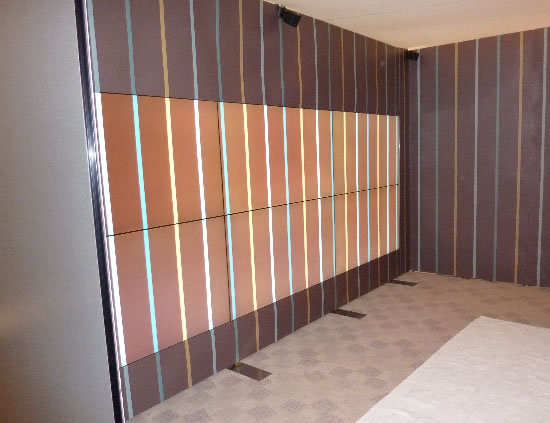
The NDS team has mocked up an entire portable room for this demonstration, which they have presented at trade shows and other industry events, along with private showings like the one at NAB. (Previously NDS called the project “Surfaces,” but changed the name to “Fresco” to avoid confusion with the recently announced Microsoft tablet product with a similar name.) The demo intends to simulate a domestic space like a typical living room, with a wallpaper pattern that is emulated in the video display as its default background (see photo). Because OLED panels are not yet widely available, the demo currently uses six conventional 55-inch 1080p LCD panels with small frame bezels (5mm), intended for use in video wall displays. The six screens are arranged three wide and two high, and fed by a single PC outputting HTML5-formatted data
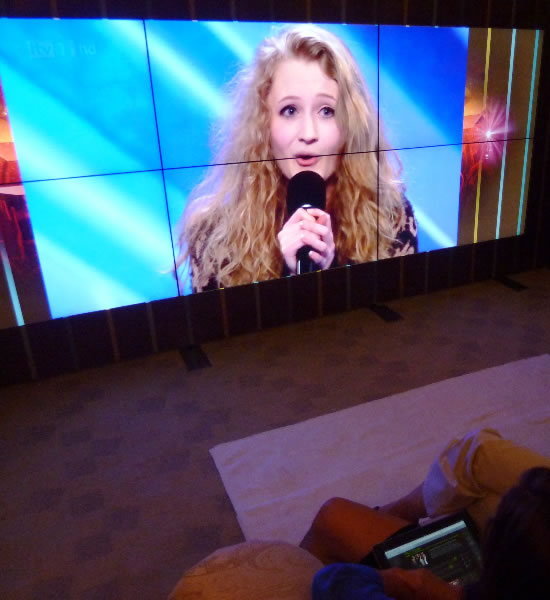
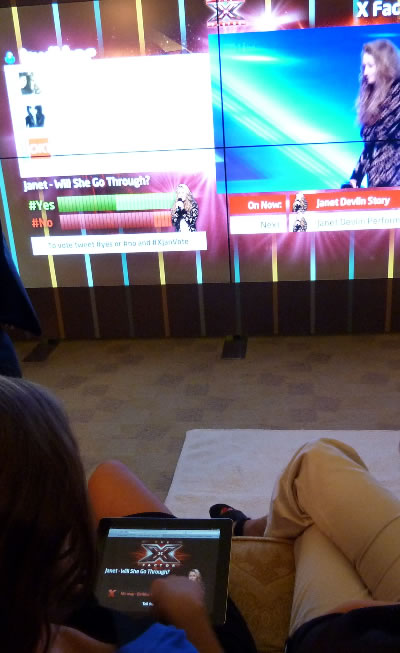
The display is controlled via WiFi by one or more tablets or smartphones, also using an HTML5-based page that allows various content sources and elements to be sized and arranged on the video wall as the user desires. These tablets also allow individual user interaction with certain elements displayed on the screen, and that interaction need not be seen on the main display, but only on that user’s tablet. For example, a news headline might appear on the large display screen, and it would be mirrored on each user’s tablet. If a user clicked on this headline on his or her tablet, the full news story would appear on that tablet, but not on the main screen (unless that user wanted to share the story with others in the room). Similarly, the availability of applications, chat-spaces, micro-blogs, etc., associated with a TV program being viewed could be “billboarded” alongside the video content on the main screen, and individual viewers could choose to launch or interact with these on their respective devices. This integration of control and interactivity via multiple, standard handheld devices in the display room enables a “collective personalization” of the consumer television experience (see photo).
Those who attended the demo agreed that it was uniquely useful in helping envision some of the options for the future of television. NDS will continue to refine and expand the project, and present it in roadshow fashion around the world. While the demo does not promote any currently available product, and NAB does not specifically endorse the company or its presentation, NAB’s Technology staff found that Fresco is a valuable demonstration to experience by anyone interested in the evolution of the creation, delivery or consumption of media in the future. NAB is currently in discussions with NDS regarding other presentation opportunities at upcoming NAB events. For further information on the Fresco project, contact Katy Flores at NDS, kflores@nds.com. All
TV Stations Must Upload New Public File Documents Starting August
2
Additional information and registration is available online. Call for Speakers and Proposals - Now Open  We
are currently in the process of developing our educational programs
for the 2013 NAB Show. More than 90,000 media and entertainment
professionals from 156 countries, including more than 1,600 industry
press representatives, attended the 2012 NAB Show. We invite you
to be part of the 2013 event. We
are currently in the process of developing our educational programs
for the 2013 NAB Show. More than 90,000 media and entertainment
professionals from 156 countries, including more than 1,600 industry
press representatives, attended the 2012 NAB Show. We invite you
to be part of the 2013 event.
Visit the Call for Speakers area of the NAB Show website to learn more about our programming emphasis areas, requirements for submission and notification process. |
 This
informative program is a can't-miss day for station engineers, broadcast
executives, the content creation community and other industry professionals.
Leading industry experts will discuss critically important topics
including:
This
informative program is a can't-miss day for station engineers, broadcast
executives, the content creation community and other industry professionals.
Leading industry experts will discuss critically important topics
including: |
|



ADVERTISEMENTS