|
NAB
Satellite Training Covers Theory, Operations, and Cost-control for
DTV Satellite Transmission
If you are concerned about getting the best performance from your
satellite links, while keeping your satellite transmission costs
reasonable, the NAB Satellite Uplink Operators Seminar can help
you. The seminar, to be held at NAB Headquarters on September 24
- 27, 2012, presents techniques that will give you the best performance
and help keep your station's costs under control.
 Sidney
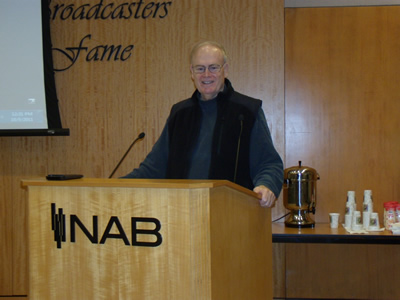
Skjei, P.E. of Skjei Telecom conducts the seminar for NAB. Mr. Skjei
has over 35 years of experience in engineering and developing a
wide range of hardware and software telecommunications products,
systems and services. He is highly knowledgeable in all major satellite
communications market areas - global, domestic U.S., and military. Sidney
Skjei, P.E. of Skjei Telecom conducts the seminar for NAB. Mr. Skjei
has over 35 years of experience in engineering and developing a
wide range of hardware and software telecommunications products,
systems and services. He is highly knowledgeable in all major satellite
communications market areas - global, domestic U.S., and military.
The seminar, which has been regularly offered by the NAB since 1989,
provides in-depth information on the theory of satellite communications,
regulatory requirements, and all operational aspects of ground equipment
for uplink and downlink facilities. The seminar's content is applicable
to distribution of signals for both analog and digital television
services. With broadcasters specifically in mind, Mr. Skjei covers
satellite news gathering topics, including vehicle design and safety
considerations. He also feels it is useful for satellite operators
to have a basic understanding of other parts of the broadcast system.
Digital television (DTV) and, in particular, high-definition digital
television (HDTV), of course, have increasing importance through
all parts of the broadcast television chain, from production to
distribution to the home, so the seminar provides significant background
information on these topics. The Compressed Digital Television and
Transmission section of the seminar covers the theory of digital
video, with an introduction to compression techniques and systems;
it concentrates on the MPEG-2 video compression format, but also
covers newer technologies such as MPEG-4 Part 10 (AVC), H.265 (HEVC)
and JPEG 2000, all of which are planned or in use today for digital
video backhaul and distribution. The various standard-definition
(SDTV) and HDTV formats used in DTV are also discussed, with detailed
analysis of how these are carried in satellite transmission systems.
The increased bandwidth requirements of HDTV can lead to higher
satellite transmission costs. Mr. Skjei discusses how these can
be reduced using new techniques enabled by advanced systems such
as MPEG-4 AVC and the recently introduced DVB-S2 second-generation
satellite transmission standard.
 The
four-day seminar provides operational training that minimizes the
risk of satellite transmission interference. This is important because
FCC rules require that "a trained operator be present at all
times during transmissions, at either an earth station site or designated
remote control point" [CFR 47 Section 25.271 (b)]. The
four-day seminar provides operational training that minimizes the
risk of satellite transmission interference. This is important because
FCC rules require that "a trained operator be present at all
times during transmissions, at either an earth station site or designated
remote control point" [CFR 47 Section 25.271 (b)].
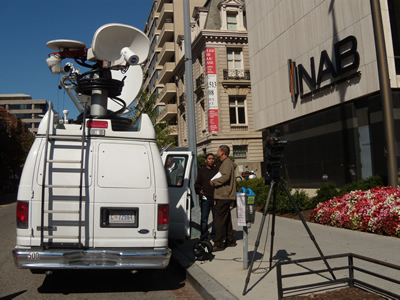
In addition to classroom instruction, participants will receive
hands-on training in a satellite newsgathering (SNG) truck, as well
as an all-day field trip to a nearby, large satellite teleport and
operations center.
"The NAB course offers many features that other satellite operators
courses do not, such as a variety of hands-on training sessions,
more hours of personal instruction, and a general satellite systems
and television focus, as opposed to just training on a specific
type of terminal - for example, a flyaway SNG terminal," commented
Mr. Skjei. "We also cover specific operations of SNG truck
terminals, including a practical session that affords students a
shirtsleeves experience in uplinking from an SNG truck."
The seminar fee is $1,250 for NAB members, and $1,550 for non-members.
The fee includes a Satellite Uplink Handbook, continental breakfasts
and lunches. Space is limited, so if you want to take advantage
of this important training opportunity, visit the Satellite Seminar
Web page,
or call Cheryl Coleridge at (202) 429-5346. If you are interested
in sponsorship opportunities for this event, contact NAB Advertising
at (800) 521-8624 or advertising@nab.org.
Reminder:
June 30 EAS CAP Deadline
No later than
June 30, 2012, all broadcast stations must have CAP-capable EAS
equipment installed and operating in their facilities. FCC rule
11.56 requires all broadcasters to have equipment installed and
operating that can receive and decode National Level (federal) Emergency
messages (EANs) encoded in the Common Alerting Protocol (CAP) format.
The original
CAP compliance deadline was March 31, 2011. In response to a petition
filed by NAB and others, the FCC extended that dead line to September
30, 2011. On Friday September 16, 2011, the FCC released an order
further extending the deadline to June 30, 2012.
This requirement
was reaffirmed in the most recent FCC EAS Report and Order released
January 10, 2012 (Fifth Report and Order in EB Docket No. 04-296
- "5th R&O"). The rules adopted in the 5th R&O
also require broadcasters to interface with and monitor FEMA's Integrated
Public Alert and Warning System (IPAWS) server for those federal
CAP-formatted EAS messages. However, because IPAWS monitoring will
be largely conducted via an Internet connection, the FCC will consider,
on a case by case basis, applications for waivers from this monitoring
requirement based on the physical lack of availability of broadband.
The 5th R&O
is available here.
The order extending the CAP compliance deadline is here.
|