|
Arbitron
Rolls Out a New PPM
Arbitron has begun
using a new version of its Personal People Meter (PPM) system, called
the PPM 360. The new client hardware distributed to PPM users (Arbitron calls them “panelists”) is significantly changed from earlier
designs, and should provide both an improved user experience and better
overall performance. It represents the most substantial upgrade that
the automated radio-listener data recorder system has undergone since
its original release in 2007.
calls them “panelists”) is significantly changed from earlier
designs, and should provide both an improved user experience and better
overall performance. It represents the most substantial upgrade that
the automated radio-listener data recorder system has undergone since
its original release in 2007.
Arbitron takes pains to note that its PPM data format, rules and collection
and reporting processes are otherwise unchanged. Results reported
by PPM 360-equipped panelists will remain fully interchangeable with
data from the company’s earlier meters. In fact, both generations
of meters will coexist in the field for some time, as Arbitron phases
in the PPM 360. (Arbitron signs up PPM panelists for one or two-year
terms, at the conclusion of which panelists return their meter hardware
to the company. Hereafter, as new panelists come on board, PPM 360
hardware will be sent to them, and the old hardware will be retired.)
Unlike previous versions of the device, the PPM 360 incorporates a
cell phone for reporting its results directly to Arbitron. This is
a significant departure from past practice, in which data was only
reported via a landline phone modem that only collected data from
PPMs when docked in their rechargers in panelists’ homes.
The PPM 360 also takes greater advantage of off-the-shelf components,
replacing formerly proprietary elements with a standard USB interface
(for power supply and headphone adapter), for example. The meter also
includes a longer-life battery (specified for 60-80 hours continuous
use between charges), and greatly increased onboard memory. The latter
was included to allow for a possible future shift to “audio matching”
technology contemplated by Arbitron – which would require potentially
long-duration recording of audio signals – as opposed to the
current approach of simply storing binary data generated by the device
upon detection of watermarks inserted in audio signals by broadcasters.
The new system also includes two wall-wart “beacons,” intended
to be plugged in at two separate places within the panelist’s
home. They communicate with the PPM 360 via Bluetooth, providing it
with a unique signal that identifies the panelist’s home. (This
is used by the PPM system to differentiate listening done at home
from listening away from the home.) It replaces a proprietary communication
from the earlier system’s data-collection hardware.
Other improvements in the PPM 360 include a smaller, lighter and more
comfortable wearable device, along with an LCD status display, showing
the panelist’s name (important when differentiating multiple
meters in a household), current total of “carry points”
earned by the panelist (these are used as incentives for the panelist
to wear the meter as often as possible), and time-of-day. Also, because
the PPM 360 includes a cellular transmitter, it requires an “airplane
mode” switch to turn off its transmitter. The transmitter can
be manually restarted by the panelist, but it automatically restarts
when the meter detects its Bluetooth home beacon. Like the earlier
system, the PPM 360 only reports data to Arbitron once a day, but
unlike its predecessor, this reporting need not take place only while
the panelist is at home.
For compatibility with data from the earlier-generation hardware,
the PPM 360 uses the same microphone and accelerometer fitted in previous
designs. Interestingly, the device’s 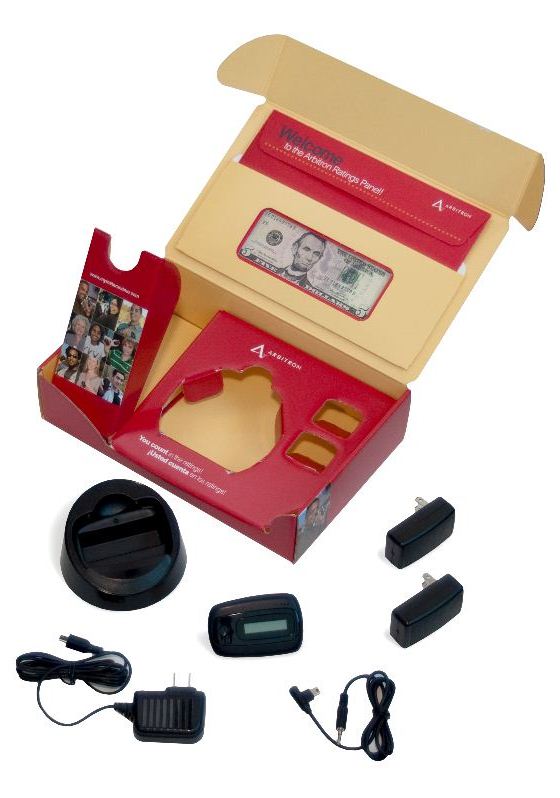 microphone
is the single most expensive component in the system, delivering hearing-aid
quality performance, with the ability to detect watermarks in acoustical
signals received at levels as low as 20 dB SPL. (This microphone’s
cost of approximately $10 is more than 30x the cost of typical communication-grade
microphones used in cell phones.) The accelerometer is used to detect
motion of the meter, to verify that a panelist is actually wearing
it (rather than the meter just sitting on a table next to a radio,
for example). Accelerometer data collected from different meters is
also compared to verify that a panelist is not wearing multiple PPMs. microphone
is the single most expensive component in the system, delivering hearing-aid
quality performance, with the ability to detect watermarks in acoustical
signals received at levels as low as 20 dB SPL. (This microphone’s
cost of approximately $10 is more than 30x the cost of typical communication-grade
microphones used in cell phones.) The accelerometer is used to detect
motion of the meter, to verify that a panelist is actually wearing
it (rather than the meter just sitting on a table next to a radio,
for example). Accelerometer data collected from different meters is
also compared to verify that a panelist is not wearing multiple PPMs.
The photo at right shows the PPM 360 package as sent to panelists,
which is also smaller and less daunting than earlier packages. From
left to right, the components include the charging dock, USB power
supply (which can be connected to the dock or plugged directly into
the meter for easier use while traveling), the PPM 360 meter, its
USB headphone adapter cable and two Bluetooth home beacons.
Arbitron reports that PPM 360 distribution to new panelists began
last month, with a market-by-market phase-in schedule that will continue
over the next two years.
IPAWS Webinar: Getting Ready
for CAP:
Countdown to June 30
On Wednesday, June
6 FEMA's IPAWS program in Partnership with the National Alliance of
State Broadcasters Association (NASBA) and NAB will hold the next
discussion in a continuing EAS Webinar Series. The webinar will be
hosted by Manny Centeno of the Federal Emergency Management Agency
(FEMA) and Suzanne Goucher of NASBA and the Maine Association of Broadcasters
(MAB).
The Webinar will discuss what EAS Participants need to know to ensure
they are prepared to receive alert messages in Common Alerting Protocol
(CAP) and will include presentations on the following topics:
- Antwane Johnson, FEMA IPAWS Director, will provide an overall
update on IPAWS developments
- IPAWS staff will discuss general EAS-CAP best-practices, EAS
device configuration, and parallel operation of the EAS using
traditional monitoring and CAP
- The Federal Communications Commission (FCC) will address recent
changes to Part 11 Rules governing EAS and what State and local
Emergency Communications Committees should be aware of as they
update their State EAS Plans
- Whit Adamson, President of the Tennessee Association of Broadcasters
(TAB) will share the steps he has taken to develop local officials'
interest in using the EAS
- IPAWS staff will provide an update on the Primary Entry Point
(PEP) Expansion Program
Event Details:
What: FEMA IPAWS Special Event - Getting Ready for CAP: Countdown
to June 30
When: Wednesday, June 6, 2012; 4:00 PM-5:00 PM ET
Where: WebEx (This link will only be active the afternoon of June
6) (https://eiip.webex.com/eiip/onstage/g.php?t=a&d=922661163)
NOTE: The audio portion of the program will be delivered via
your computer speakers. Please review the instructions posted at:
http://www.emforum.org/WebExInstructions.htm
prior to the program.
Webinar
Login: The following login link can be used not earlier than
30 minutes prior to the scheduled meeting time:
https://eiip.webex.com/eiip/onstage/g.php?t=a&d=922661163
The password is attend.
Questions can be directed to the FEMA IPAWS email address: ipaws@dhs.gov,
Manny Centeno, or Suzanne
Goucher.
Participate in the Radio Show!
The Radio Show
is the ultimate venue for connecting with radio. There’s no
better place to interact one-on-one with thousands of radio professionals
- from station management to CEOs, sales managers to digital and
marketing directors, engineers to program directors. Formulate your
marketing plan to take advantage of this audience by contacting
NAB Advertising for more
information. Exhibit, sponsorship and advertising opportunities
are available!
|