|
Broadcasters
Take on the "Second Screen"
A recent announcement
by a group of broadcasters has once again brought attention
to the subject of the so-called "Second Screen." Broadcasters
are quickly becoming familiar with this new term, but for those
who may not yet be fully conversant with the subject or the technologies
behind it, this week's TechCheck presents an overview of
the latest thinking about it.
Second Screen Explained
"Second Screen" refers to the increasingly popular behavior
among television viewers to simultaneously use a personal computing
device while they are watching a TV program, for purposes that are
somehow related to the TV program. While this activity has been in
evidence for a number of years (initially via laptop PCs), the more
recent proliferation of smartphones and tablets has stimulated a marked
increase in the practice among consumers, to the point where the term
"Second Screen" is now becoming a widely used term of art
in media circles.
Most activity on the second screen device to date has been strictly
user-initiated. This includes web searches for related content or
postings on the popular social media sites. More recently, some
TV-specific social media sites have sprung up (so-called "Social
TV" services, as described in the July
25, 2011 edition of TV TechCheck).
The latest wrinkle adopted by broadcasters in their recent announcement
allows a TV channel to direct the user's second-screen experience,
by sending the second screen to a corresponding website that presents
companion content to the current program. The content can be presented
dynamically and synchronously, meaning that as the TV program proceeds,
the second-screen content also updates accordingly. The process works
whether the program is viewed live as broadcast, or from a user's
local storage (e.g., DVR).
Enabling Technology
There are numerous technologies that can enable such coordination
between devices. One popular technique is generically referred to
as Automatic Content Recognition (ACR). ACR systems today
typically utilize one or both of two basic processes, called Watermarking
and Fingerprinting.
Watermarking inserts a frequent or continuous identifying signal
into the audio or video of the program content. The watermark signal
is imperceptible to human users, but recognizable by target devices.
The signal must be adequately robust to pass through downstream
processing, recording and playback, and must remain recognizable
over noise and distortions that may occur in the end-user's environment.
(Familiar examples of watermarking are the technologies used by
today's electronic audience measurement systems, where each broadcast
service includes a unique identifying watermark signal that is recognized
by the reporting device.)
On the other hand, Fingerprinting does not require the insertion
of an identifying signal. Instead, the end-user's device includes
a client that examines the audio or video of a particular piece
of content for specific characteristics inherent to it, and then
compares the result to an online library of similar analyses. If
a match is found, the content is thereby identified to the user
device. (Familiar applications of this technique are the music identification
apps that have become popular on smartphones, whereby a user holds
the smartphone near a speaker playing music for a few seconds, and
the app returns title and artist information.)
Although both processes can be used in tandem, certain applications
may be better served by one or the other approach. For example,
Fingerprinting may be more applicable when a particular piece of
content requires similar identification across a range of distribution
venues, whereas Watermarking may be preferred to identify a particular
instance of that content, such as when it is broadcast over a channel
that must be discretely identified (especially when that channel
is one of many local affiliates of a national network, many of which
may be broadcasting their own instance of that same content at the
same time). Further, because Watermarking is frequently or continuously
inserted in the content, it may be more appropriate for signaling
dynamic associations, such as where time synchronization of a second
stream of content is required. In contrast, Fingerprinting is a
more static identifier of an entire program (or at least a particular
program segment).
Broadcasters Take Control
The method chosen by this new alliance of local broadcasters appears
to use audio watermarking for ACR. Users will download a free app
to their second-screen device(s) called ConnecTV. The app
uses the device's microphone to listen to a TV program's soundtrack
(via simple acoustical monitoring in the viewing room), and extracts
the watermark signal. Using the watermark to identify the content
and station the app can then navigate to the appropriate online
location where second-screen content is stored, and synchronize
its display to the part of the program that is currently being viewed.
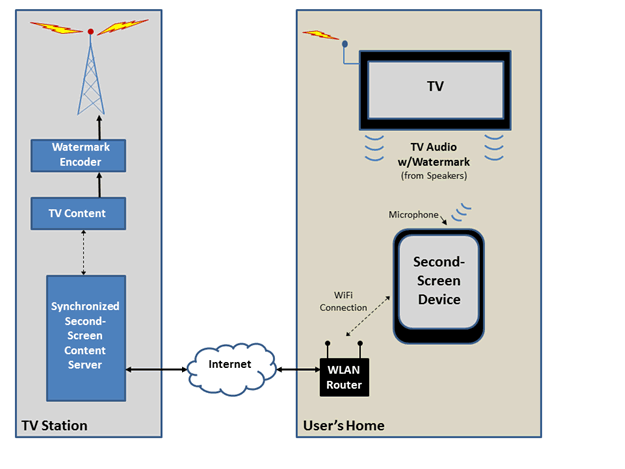
The second screen content can include synchronized ancillary content
(e.g., sports-player stats, drama-character backstories, links to
further information), interactive elements (e.g., play-along games,
polls, e-commerce), and brand-extension or promotional content for
the station, program or advertiser. (Material related to a station's
local ad inventory can be included in the second-screen content.)
The app also includes a social media platform allowing viewers to
interact with one another, and a recommendation engine offering
promotional opportunities for similar content.
ConnecTV is already in use for national channels and programs,
but the station group announcement marks its first foray into local
TV channel application. The service is currently in a closed beta,
and is scheduled for open launch in early 2012. For more about the
ConnecTV partnership, and some examples of the app in use,
look here.
|