|
 |
 |

|
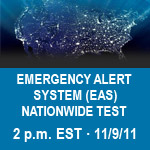
Nine Days and Counting until Nationwide EAS Test The first nationwide test of the Emergency Alert System (EAS) is
only 9 days away. Now is the time to make sure your station is fully
prepared. The test will be conducted by the U.S. Department of Homeland
Security Federal Emergency Management Agency (FEMA) and the Federal
Communications Commission (FCC) on Wednesday, November 9, 2011
at approximately 2 p.m. (EST). Additional information is available on our website,
including a Nationwide EAS Test visual slide that television stations
should insert during the test to help persons with hearing disabilities
and other viewers fully comprehend that the Broadcasters are the backbone of the Emergency Alert System. We
are a critical lifeline for many Americans during times of disaster,
and given our indispensable role as first informers during emergencies,
it is imperative that we work with our federal partners to regularly
test the EAS system. |
|
Audio
Recordings of FASTROAD SFN FM HD Radio Tests Now Available These recordings offer an opportunity to experience how the digital booster impacts the received analog audio quality for three different scenarios as a test vehicle drives towards the booster site. Since the digital-to-analog signal ratio will be increasing above the nominal -20 to -10 dBc value as the receiver gets closer to the booster, the quality of the received analog audio in this situation is of interest. In each case the booster signal is augmenting the hybrid HD Radio signal from WKLB's main transmitter. The first two scenarios involved use of a digital-only (i.e., no analog component) booster's effect on the main transmitter's analog signal as received on a Chrysler and a Delphi automotive receiver. The third scenario examines the effect of adding a low-power, synchronized, FM-modulated, analog carrier to the digital booster signal, to reduce the analog host interference caused by the digital carrier in the immediate vicinity of the booster. The recording for this third case was of analog audio as received on a Delphi automotive receiver.
To access these video files, go to the FASTROAD projects Web page and scroll down to the "Single Frequency Network Analysis" project. The hyperlinks for the individual files are as follows: WKLB
SFN Compat Dig-Boost - Delphi NAB Accepting Nomination for 2012 NAB Engineering Achievement Awards NAB is currently accepting nominations for the 2012 NAB Engineering Achievement Awards. Established in 1959, the NAB Engineering Achievement Award is presented each year to an individual for their outstanding accomplishments in the broadcast industry. In 1991, NAB began giving awards separately for achievements in radio and television. The award winners will be recognized at the Technology Luncheon at 2012 NAB Show on April 18 in Las Vegas, Nev. Additional
information and a nomination form are available on NAB's
website. The deadline for nominations is January 23, 2012.
The October 31, 2011 Radio TechCheck is also available in an Adobe Acrobat file. Please click here to read the Adobe Acrobat version of TV TechCheck. |
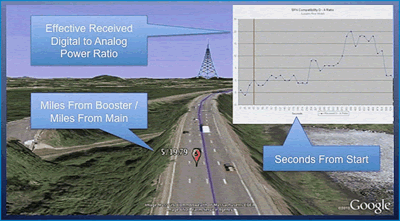 Each
receiver's audio was integrated with an animated Google Earth
rendering of the route and an animated, synchronized copy of a
chart indicated the predicted digital-to-analog signal power ratio
at the receiver, as shown in the image at right. For all three
scenarios, the digital-only booster was operating at a power level
of 27 watts ERP; for the third scenario, a 3 watt ERP analog signal
component was added to the digital booster's output.
Each
receiver's audio was integrated with an animated Google Earth
rendering of the route and an animated, synchronized copy of a
chart indicated the predicted digital-to-analog signal power ratio
at the receiver, as shown in the image at right. For all three
scenarios, the digital-only booster was operating at a power level
of 27 watts ERP; for the third scenario, a 3 watt ERP analog signal
component was added to the digital booster's output.
ADVERTISEMENTS