|
23
Days Until the National EAS Test
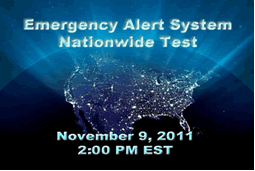 There
are only 23 days left to the first-ever, coordinated, end-to-end
test of the nationwide Emergency Alert System (EAS) on November
9, 2011. By FCC rule, all Radio and Television stations, including
Non-participating National stations (NN), must participate in the
November 9 National test. Here's what you need to know: There
are only 23 days left to the first-ever, coordinated, end-to-end
test of the nationwide Emergency Alert System (EAS) on November
9, 2011. By FCC rule, all Radio and Television stations, including
Non-participating National stations (NN), must participate in the
November 9 National test. Here's what you need to know:
The Basics
The test
will be originated at 2 p.m. eastern time on November 9.
The National
EAS Test will utilize the Emergency Action Notification (EAN)
code. This is a "live-code" test, i.e. it will use the
code that would be used in an actual national emergency.
The Alert
will be transmitted through the Primary Entry Point (PEP) network
of stations. All broadcast stations should verify their monitoring
assignment to ensure that they can receive the EAN. The EAN may
also be available via your local National Public Radio (NPR) station.
If you believe that your station will not be able to receive the
EAN, immediately contact the FCC or FEMA (see below).
The test
will be approximately 3.5 minutes in duration (the audio message
will be 2.5 minutes long to ensure that EAS equipment will not
"lock up" after two minutes - the maximum length for
all other EAS alerts).
The audio
portion of the test will state that "This is a Test."
NOTE: the text crawl automatically generated by stations'
EAS equipment will state they this is an EAN and will not indicate
that the event is a test.
To minimize
public confusion and to ensure that the test is fully accessible,
TV stations should insert a background graphic (or other visual
element) behind the EAS crawl that clearly indicates to their
viewers that "THIS IS A TEST." A sample graphic
is provided here.
The test
will not use the new CAP-based alerting technology.
All stations are responsible for ensuring that EAS encoders and decoders
are installed and configured so that the monitoring and transmitting
functions are available during the times that the station is in operation.
FEMA has assembled a set of EAS Best Practices by which EAS Participants
may check to see if they are maintaining their EAS equipment in good
working order. These best practices may be found on FEMA's National
EAS test website.
EAS Test
- Mandatory Reporting
FCC Rules require all EAS participants to provide results of the
EAS national test within 45 days of the test date. Under these requirements,
EAS Participants must report and submit to the Commission the following
test-related diagnostic information:
The EAS Participant's
facility identification information;
The EAS Participant's
EAS designation (NP, SP, LP-1, etc.);
The geographic
location of the EAS Participant's facility;
The make and
model number of EAS Participants' EAS equipment;
The date/time
of receipt of the EAN message;
Who the EAS
Participant was monitoring at the time of the test;
Whether the
EAS Participant received the alert message during the designated
test;
Whether it
retransmitted the alert if required;
If the EAS
Participant was not able to receive and/or transmit the alert, it
must supply a detailed diagnostic analysis regarding the cause(s)
for such failure.
The FCC has
established an on-line EAS National Test Reporting System. This
electronic submission system should impose a lesser burden on
EAS Participants because they will be able to input electronically
the above information. The FCC has indicated that all information
collected will be kept confidential. The FCC is expected to announce
that link for the on-line system within the next week.
Public
Outreach
The broadcasting industry has pledged to help increase public
awareness of the nationwide EAS test. NAB has worked with FEMA
and the FCC on the production and distribution of public service
announcements (PSAs) designed to promote awareness. NAB strongly
encourages every station to download and air one or more of the
PSAs available on NAB's EAS Web page or to use one of the template
scripts to tailor your own PSA. NAB recommends that stations start
airing nationwide EAS test PSAs at least one week before the test,
and with increasing frequency as November 9 approaches.
Contacts:
FCC:
Gregory M. Cooke
Associate Chief, Policy and Licensing Division
Public Safety & Homeland Security Bureau
Federal Communications Commission
(202) 418-2351 (office)
gregory.cooke@fcc.gov
|
FEMA:
Manny Centeno
Program ManagerIPAWS Program Office
National Continuity Programs
Department of Homeland Security
(202) 646-4328 (office)
(202) 538-4199 (mobile)
manuel.centeno1@dhs.gov
|
Detailed information
about the National EAS test, including TV and Radio PSAs and links
to FCC, FEMA and other organizations websites, is available here.
Check back frequently for updates.
|