|
 |
 |

|
Delivering the Best HD Radio Experience
To that end, the HD Radio Alliance has formed an HD Radio Technical Standards Task Force with the goal of identifying exactly what HD Radio broadcasters need to do to help deliver the kind of consistent experience needed to make HD Radio audio and data services as successful and competitive as they can be. Paul is co-chairing this Task Force along with CBS Senior VP Glynn Walden, and their group is composed of leading engineering executives from the HD Radio Alliance membership. With the support of the HD Radio Alliance, iBiquity Digital Corporation and NAB, the Task Force has identified eight operational priorities all digital radio broadcasters should strive to address. The Task Force members believe that by implementing these procedures and services on all HD Radio stations, the industry will be able to ensure a high-quality and consistent listener experience across all stations, markets and groups. Here is a brief summary of these eight items (click on the hyperlinks for more detailed information about each):
Digital
power increase
– FM band HD Radio stations should take advantage of whatever
digital power increase is possible without exceeding the NRSC-5 out-of-band
emissions mask for HD Radio operation. A number of methods and options
for doing this are identified by the Task Force, depending upon the
configuration of the transmission facility: Time and level alignment – proper time alignment of the main channel analog and digital audio signals is necessary as the HD Radio receiver transitions or blends from the main channel analog to the digital audio when first tuned to a station, or at the edge of the digital signal coverage where the receiver will blend back to the analog signal. Alignment requires the main analog audio signal to be delayed approximately 8 seconds to match the digital audio’s time delay. The audio levels between the two audio streams must also be matched so there is a smooth transition when the receiver blending occurs. When the audio delay and level are set correctly, the blend between the analog and digital streams is seamless. Complete and accurate SIS – Station Information Services (SIS) data provides basic information about the station such as call sign, as well as information not displayable to the consumer such as the station identification number. Broadcasters should ensure that the SIS data broadcast are accurate and complete. The SIS information is, in general, common to all programs, since it originates at the exciter/exporter, whether or not the broadcast system includes an importer for SPS programs. Refer to the NRSC-5 reference document SY_IDD_1020s for further details. Dynamic Program Service Data (PSD) - Program Service Data (PSD) is an important component of the HD Radio listener experience and should be sent for each song that is played. “Dynamic PSD” is PSD that changes with every song. With Dynamic PSD, the specific Song Title and Artist information is displayed related to the song being currently played. Accurate display of the PSD fields for the main program (HD1) as well as all the multicast (HD2, HD3, etc.) programs is important so that songs are clearly identified for the listener and may be tagged properly for later purchase through the iTunes Tagging feature. According to the Task Force web page, there are various studio automation vendors that support the implementation of dynamic PSD such as ENCO Systems, RCS, TRE, Arctic Palm and WireReady. iTunes tagging support – the iTunes Tagging feature allows a listener to identify a particular song on a HD Radio broadcast. iTunes Tagging data should be sent for every song played. When a song is tagged by the listener, a token is stored in the receiver and the listener may later purchase the song through the iTunes music store. Much of the information required for tagging is already sent in the PSD and the SIS data fields. In addition the product codes are sent in the UFID fields contained within the ID3 tags of the PSD data. For iTunes tagging to work, the Song Title and Artist information must be populated in the correct fields by the studio automation system. PSD messages must arrive at the broadcast equipment within 0.5s of each new segment or song, and only one PSD message should be received per audio segment or song. 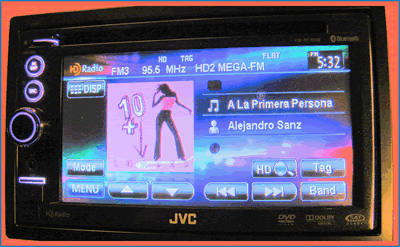
Artist Experience - Artist Experience is the synchronous transmission, delivery and display of images on the receiver related to the specific audio segment, and should be implemented by all HD Radio broadcasters. The photo at right illustrates an example of an Artist Experience image (cover art) which was being broadcast over Chicago station WNUA-FM (95.5 MHz) during the Radio Show. Artist Experience images may also include artist photos, slide shows or other images related to the song or audio being played. Commercial images related to an advertisement segment can also be displayed using this feature. The image is displayed in a tightly synchronized fashion with the song or audio being played and displayed. If the Cover Art or primary image is unavailable, the station logo (see below) or other default image should be displayed on the receiver. Contact iBiquity for further details on the analysis for bandwidth requirements to support the Artist Experience. 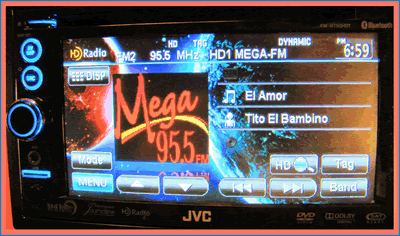
Station
logo service –
transmission of station logos is supported by the iBiquity “Artist
Experience” feature which should be implemented by all HD Radio
broadcasters. Station logos are images that are not synchronized
with the audio. The station logo image is not expected to change
very often – see photo at right for an example of a station
logo which was being broadcast over Chicago station WNUA-FM (95.5
MHz) during the Radio Show. Station logo images should be stored
automatically in non-volatile memory on the receiver for quick display
and a better user experience. HD-1, HD-2, etc. can all have separate
station logo images. This enhances the ability of each program to
have its own unique personality. Station logos: High-quality multicast engineering - multicasting is the ability for an HD Radio-capable FM station to broadcast additional audio programming (called Supplemental Program Service or SPS) simultaneously with the main audio program service (called Main Program Service or MPS). The configuration of the various multicast channels can be set by the broadcaster to support various program formats. There is currently no multicasting available for AM band HD Radio stations. It is recommended that no more than 3 multicast channels (HD2, HD3, HD4) be broadcast in addition to the main analog service (HD1). Broadcasters who are part of a HD Radio data services network, such as the Broadcaster Traffic Consortium (BTC) or the Total Traffic Network (TTN) should consult service provider documentation to ensure bandwidth allocations comply with the applicable data providers requirements. |
 During
the Engineering Program portion of last month’s
During
the Engineering Program portion of last month’s |
61st
Annual IEEE Broadcast Symposium The 61st
Annual IEEE
The October 3, 2011 Radio TechCheck is also available in an Adobe Acrobat file. Please click here to read the Adobe Acrobat version of Radio TechCheck.
|
 Broadcast
Symposium is being held from October 19-21, 2011 at the Westin
Alexandria Hotel in Arlington, VA. This year’s Symposium
will offer attendees an exciting, timely, and informative three-day
program with tutorials on “Connected TV” and HD Radio
in-band/on-channel digital radio technology, followed by technical
sessions on Radio Engineering & RF Infrastructure, Network
Distribution, Mobile DTV, DTV Implementation, and the Future of
DTV. Broadcast engineering experts from around the world will
be presenting at the Symposium. For additional information and
to register visit the Symposium web site at
Broadcast
Symposium is being held from October 19-21, 2011 at the Westin
Alexandria Hotel in Arlington, VA. This year’s Symposium
will offer attendees an exciting, timely, and informative three-day
program with tutorials on “Connected TV” and HD Radio
in-band/on-channel digital radio technology, followed by technical
sessions on Radio Engineering & RF Infrastructure, Network
Distribution, Mobile DTV, DTV Implementation, and the Future of
DTV. Broadcast engineering experts from around the world will
be presenting at the Symposium. For additional information and
to register visit the Symposium web site at 

ADVERTISEMENTS