|
 |
 |

|
AM
Carrier Control Offers Power-saving Options For many years, international AM broadcasters have been using power-saving technologies that reduce the amount of power transmitted in the carrier portion of an AM radio signal while maintaining the quality and coverage area of the station. In a Public Notice released earlier this month, the FCC has now made it possible for AM broadcasters in the U.S. to benefit from this technology. In the Public Notice, the Media Bureau establishes procedures for AM broadcasters to seek a rule waiver in order to use energy-saving Modulation Dependent Carrier Level (MDCL) technologies. The Commission suggests that easier implementation of MDCL algorithms and higher energy costs have recently made these techniques more attractive to domestic broadcasters. 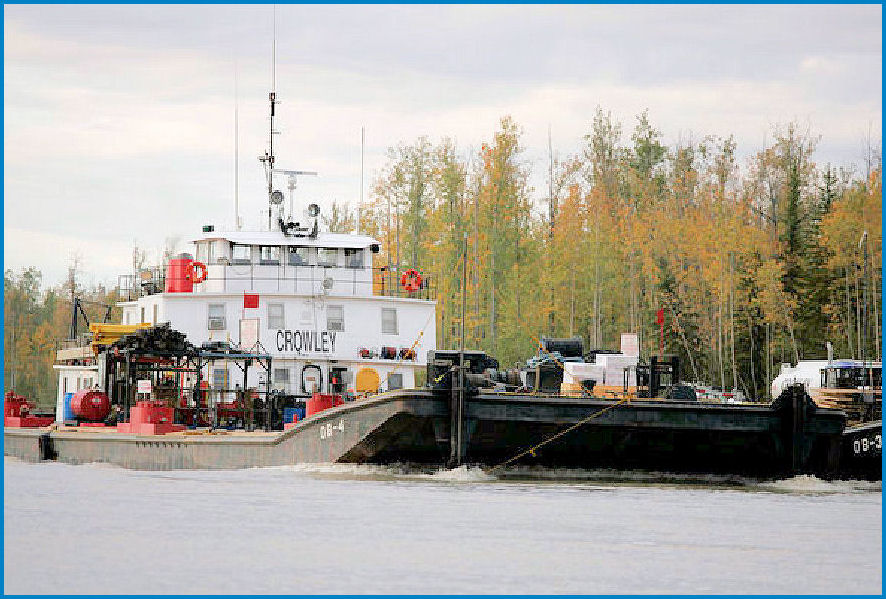
This Public Notice follows a wave of interest in these technologies within the U.S. broadcasting industry, including technical presentations at recent NAB Broadcast Engineering Conferences. At the 2011 NAB Show, Chuck Lakaytis, director of engineering with Alaska Public Broadcasting gave a presentation entitled “Reduce Power Co$t$ of AM Transmitters using Carrier Control Techniques.” In Alaska, energy costs are at a premium so these power-saving technologies are of considerable interest. In his presentation, Mr. Lakaytis said that many of the eleven AM radio stations in the Alaska Public Broadcasting system rely upon diesel generators for AC power, and the fuel for these is often delivered by barge (see photo of the “Crowley fuel tug” delivering fuel on the Tanana River) or aircraft. 
Under experimental authorization, Alaska Public Radio investigated the use of MDCL technology on two stations, KOTZ (720 kHz, 10 kW, Kotzebue, Alaska) and KDLG (670 kHz, 10 kW, Dillingham, Alaska). According to Mr. Lakaytis, over a 90 day trial period, these stations experienced a power savings of 30% with no complaints about audio quality or loss of coverage. In an earlier presentation, Tim Hardy, head of engineering with Nautel, spoke about “Energy Conservation in AM Broadcast Transmitters Using Carrier Control Algorithms” at the 2009 NAB Broadcast Engineering Conference. Mr. Hardy provided a brief history of the use of AM carrier control techniques followed by a technical description of how these techniques work. One technique he discussed, called Dynamic Amplitude Modulation (DAM) was commercialized by Telefunken (then AEG Telefunken, today Transradio) during the 1980s. The graph above illustrates the principle behind DAM – the carrier power is reduced the most at moderate modulation levels, increasing received loudness, and the carrier is increased at higher modulation levels so that distortion does not occur. MDCL technology has also been a topic of discussion at recent meetings of the AM and FM Analog Broadcasting (AFAB) Subcommittee of the National Radio Systems Committee (NRSC). With this action by the FCC, the AFAB is now likely to consider developing an NRSC Guideline which would help broadcasters best utilize this technology. One outstanding question is whether MDCL technology can be effectively used on a station that is broadcasting an AM in-band/on-channel (IBOC) digital radio signal. A number of broadcasters and transmitter manufacturers have expressed interest in testing how well IBOC receivers work when presented with MDCL-processed signals. The NRSC is closely following this work and will review any test results made available. Use of MDCL technologies will now only require a waiver of Section 73.1560(a) of the Commission’s Rules, which sets upper and lower limits for an AM station’s operating power. Details on how to request this waiver are included in the Notice. Some additional background information on MDCL technology is presented in the Public Notice as well, in particular:
The Commission states in the Notice that if other manufacturers of AM broadcast transmitters develop similar technology in the future, they will consider waiver requests for implementation using the same procedures described in the Notice. A telephone call to the Media Bureau last week revealed that the first request for a waiver under the terms of this Public Notice has already been received, for an AM station in California.
|
|
FEMA
IPAWS Special Event - Prepared & Ready: The meeting will be held on Microsoft Live Meeting 2007 (This link will be active the morning of September 30). Additional information is available here. 61st
Annual IEEE Broadcast Symposium The 61st
Annual IEEE Broadcast Symposium is being held from October 19-21,
2011 at the Westin Alexandria Hotel in Arlington, VA. This year’s
Symposium will offer attendees an exciting, timely, and informative
three-day program with tutorials on “Connected TV” and
HD Radio in-band/on-channel digital radio technology, followed
by technical sessions on Radio Engineering & RF Infrastructure,
Network Distribution, Mobile DTV, DTV Implementation, and the
Future of DTV. Broadcast engineering experts from around the world
will be presenting at the Symposium. For additional information
and to register visit the Symposium web site at http://bts.ieee.org/broadcastsymposium/.
The September 26, 2011 Radio TechCheck is also available in an Adobe Acrobat file. Please click here to read the Adobe Acrobat version of Radio TechCheck.
|



ADVERTISEMENTS